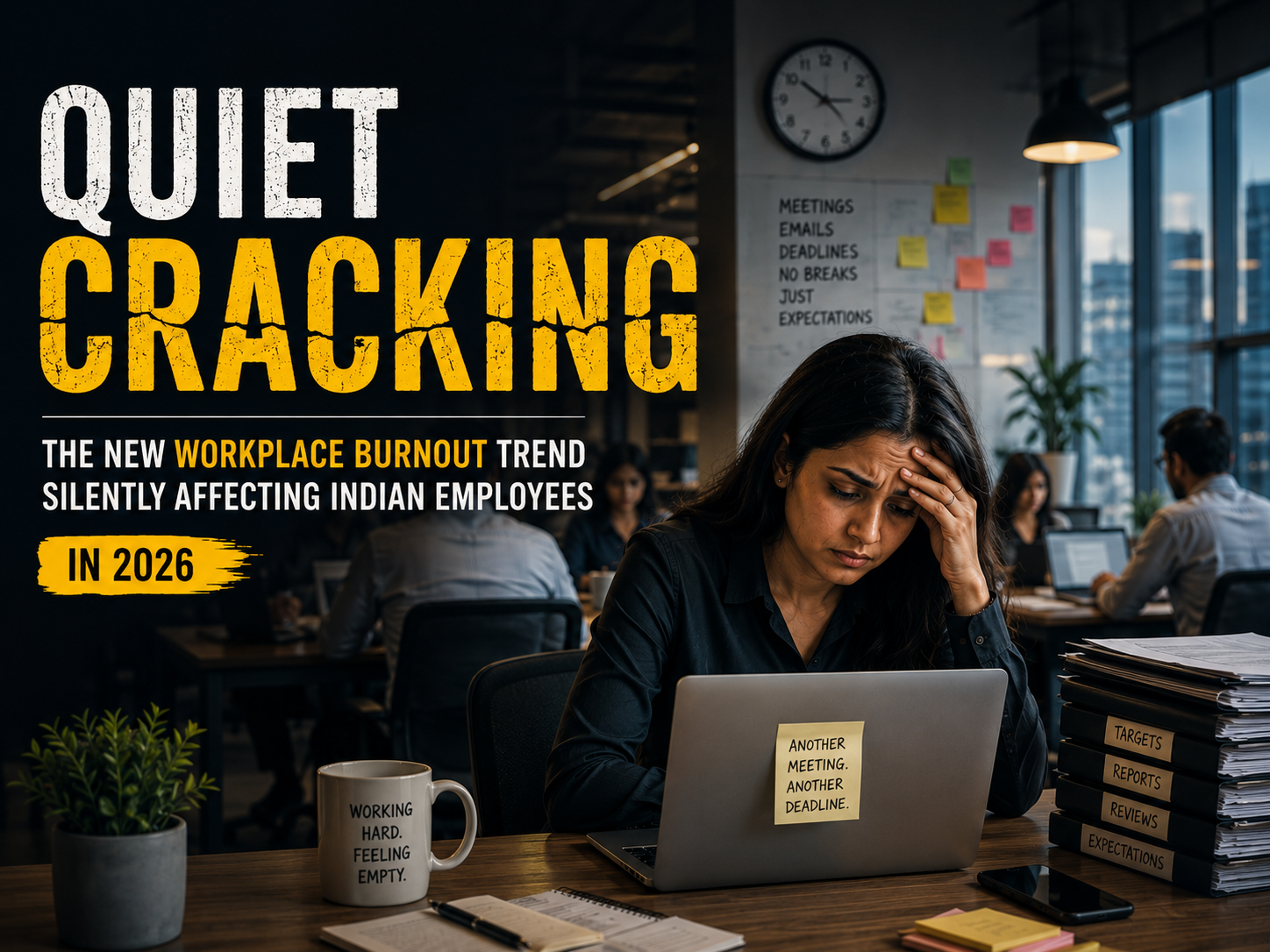
Quiet Cracking, the Burnout Nobody’s Actually Talking About in Indian Offices Right Now

Quiet Cracking, the Burnout Nobody’s Actually Talking About in Indian Offices Right Now

A few years back everyone was talking about quiet quitting. People just doing what the job description said and nothing more. That’s old news now. There’s something else moving through Indian offices in 2026, and it’s harder to spot because it doesn’t look like anything from the outside. People show up. Sit through meetings. Hit their deadlines. Look completely fine on paper. Underneath that though, running on empty, mentally checked out, just barely holding it together. That’s quiet cracking workplace India. And honestly, it’s probably happening to someone on your own team right now without anyone noticing a thing.

At New Indian Statement, we think this genuinely matters, not just for individual wellbeing but for how businesses actually function and how the economy holds up more broadly. Catching this early, as an employee and as a manager both, makes a real difference.

What Quiet Cracking Actually Is

The term describes employees still technically doing their jobs, but quietly reaching a breaking point emotionally and mentally while nobody around them notices. Not a dramatic burnout moment where someone snaps or walks out. This builds slowly. Nobody announces it. People just keep working while stress, anxiety, and exhaustion pile up underneath.

The tricky part, a lot of managers don’t catch it until productivity noticeably drops. Or worse, until a genuinely valuable employee just quietly resigns out of nowhere.

Why This Is Getting Worse in India Specifically

A handful of workplace shifts have fed into this.

Hybrid and remote work gets a lot of the blame, fairly so. Genuinely improved flexibility for a lot of people. But it’s also blurred the line between work and everything else almost completely. Notifications keep pinging well into the evening. A lot of people just never fully log off anymore, mentally or literally.

Performance pressure has ramped up hard too, especially in sectors like IT, finance, digital marketing, consulting, healthcare, and e-commerce, where Indian companies are expanding at a genuinely rapid clip. Deliver faster. Keep learning new tools constantly. Hit aggressive deadlines. Juggle more responsibility than before. Over time that pressure wears people down, mentally and physically both.

Economic uncertainty plays a quiet role too. A lot of professionals worry about job stability right now, and that worry keeps people from actually speaking up about how exhausted they are. Fear of looking less committed. Fear it’ll cost a future promotion. That silence is honestly a huge part of why quiet cracking workplace India has become such a widespread pattern.

And then there’s plain digital overload. Most professionals bounce constantly between email, Teams, Slack, WhatsApp, Zoom, whatever project tool their company’s using that month. All those notifications chip away at concentration and pile on cognitive fatigue. People end up looking busy all day without actually getting much done, which just adds frustration on top of exhaustion.

The Actual Signs to Watch For

Quiet cracking tends to build over months, not days. Easy to miss if you’re not looking for it.

Constant mental fatigue is a big one, waking up already tired even after a full night’s sleep. Motivation fades too, tasks that used to feel engaging start feeling repetitive and draining. Irritability creeps up, small workplace annoyances suddenly feel like huge deals. Creativity takes a hit, coming up with ideas or contributing during brainstorms gets harder. Emotional detachment shows up too, people stop joining in on casual conversations or team activities. They attend meetings but barely engage. And despite putting in long hours, productivity actually drops, mental exhaustion eats away at focus even when someone’s technically at their desk the whole time.

What This Actually Costs Businesses

The impact reaches well past the individual employee.

Turnover tends to climb quietly. Talented people start looking elsewhere without ever raising a concern first, then just resign the moment a better offer lands. Innovation slows down too, creativity genuinely requires emotional energy, and burned out employees just don’t have much left to contribute. Customer experience often takes a hit as well, employees struggling internally tend to respond slower, deliver lower quality service, and customers eventually notice that shift even if they can’t name why. Absenteeism tends to rise too, mental fatigue often shows up physically, headaches, disrupted sleep, recurring illness, which adds up to more sick days and lower overall output.

Which Industries Feel This the Hardest

Every sector deals with some version of this, but a few show up more consistently, IT, digital marketing, banking, consulting, healthcare, customer support, startups, media, e-commerce. Professionals here tend to juggle heavy workloads alongside business expectations that keep shifting fast, which makes them especially vulnerable to this particular kind of burnout.

What Employees Can Actually Do

Preventing this really starts with recognizing your own limits before you hit them.

Setting actual boundaries around work matters, avoiding checking emails late at night unless it’s genuinely urgent. A real separation between work and personal life ends up supporting better productivity long term, not less. Taking regular breaks throughout the day helps too, even something as small as a ten minute walk genuinely refreshes concentration. Speaking up early is worth doing, bringing up workload concerns before they become overwhelming, since most managers genuinely prefer catching problems early over losing an experienced employee later without warning. Prioritizing sleep matters more than people give it credit for, it supports emotional resilience, sharper decision making, better focus generally. And continuing to learn and grow professionally is worth doing, just without the constant comparison trap that comes from scrolling LinkedIn and measuring yourself against everyone else’s highlight reel. Learning should feel sustainable, not exhausting.

What Employers Can Actually Do

Organizations carry real responsibility here too.

Encouraging genuinely open conversations matters a lot, employees need to feel safe bringing up workload struggles without fear of being judged for it. Measuring actual results rather than hours logged helps too, long hours don’t automatically mean better output, focusing on outcomes instead of screen time tends to build healthier habits overall. Training managers to actually recognize the signs, emotional exhaustion, disengagement, early burnout, matters enormously, supportive leadership often catches this before someone reaches a genuine breaking point. Offering real flexibility helps too, actually letting people balance work with their personal life, not just technically permitting remote work while still expecting round the clock availability. And investing in employee wellbeing genuinely, through mental wellness programs, counseling support, wellness workshops, regular check-ins, shows people the organization actually values them beyond just their output.

Where Technology Fits Into All This

AI is reshaping workplaces across India fast. Genuinely improving efficiency in a lot of ways. But it’s also created new pressure to constantly keep upskilling just to keep up. Companies really need to make sure technology’s actually complementing human work rather than adding to the stress pile. Ideally, AI handles the repetitive stuff so people can actually focus on creativity, strategy, and genuine collaboration, not just another thing employees have to master on top of everything else.

Why This Should Actually Matter to Leadership

Ignoring this gets expensive fast. Replacing an experienced employee costs a lot more than simply keeping them in the first place. Employees who are actually doing well tend to be more productive, more innovative, better at collaborating, more loyal, generally better representatives of the company to customers. Organizations that genuinely prioritize wellbeing tend to build stronger reputations as employers too, which makes attracting good talent a lot easier down the line.

Where This Is All Heading

As workplaces keep evolving, conversations around mental health are only becoming more central, not less. The rise of quiet cracking workplace India really points to a growing need for actual balance between productivity and genuine wellbeing, rather than treating the two as opposites.

Success shouldn’t just get measured by long hours or constant availability anymore. Sustainable performance really comes from people who feel genuinely supported, respected, and motivated, not just from people who never say no. Companies that recognize this shift early are going to be a lot better positioned to hold onto good talent, keep innovating, and build workplace cultures that actually hold up over time.

Frequently Asked Questions

What does quiet cracking actually mean at work?

It describes employees who keep performing their jobs while silently dealing with emotional exhaustion, stress, and burnout, without ever openly saying they’re struggling.

How is this different from quiet quitting?

Quiet quitting is about limiting effort to exactly what’s assigned. Quiet cracking is different, people feeling genuinely overwhelmed internally while still trying hard to meet expectations.

Why is this becoming so common in India specifically?

Long hours, hybrid work models, economic uncertainty, digital overload, and rising performance expectations have all fed into the growth of quiet cracking workplace India specifically.

What are the early warning signs to watch for?

Constant fatigue, fading motivation, emotional detachment, irritability, dropping productivity, trouble concentrating, and reduced creativity.

How can companies actually prevent this?

By encouraging open communication, setting realistic workloads, genuinely supporting work life balance, training managers to spot the signs, and actually investing in employee wellness.

Can this actually affect business performance?

Yes, genuinely. Tends to show up as lower productivity, higher turnover, less innovation, more absenteeism, and a decline in customer experience over time.

Author

  • New Indian Statement Magazine is a modern lifestyle and culture platform that highlights fashion, travel, food, relationships, spirituality, and trending conversations. It brings fresh perspectives, celebrity features, and insightful stories that reflect contemporary Indian living.

Related Posts

Minimal Skincare Routine for Busy Professionals in 2026

Minimal Skincare Routine for Busy Professionals in 2026

Somewhere between the early meeting, the commute, the deadline due by lunch, and answering emails at eleven at night, skincare quietly slides off most people’s priority list. Not because people stop caring about their skin. Honestly, the real problem’s usually simpler than that. Most routines out there just feel like too much. Ten steps. Five serums. A mask for this, an exfoliator for that, a different product for every possible concern under the sun. Stops feeling like self care. Starts feeling like one more task competing with everything else on your plate. That’s really where a minimal skincare routine 2026 approach makes sense. Instead of collecting products, the whole point is picking a few things that actually work and sticking with them. Keeping skin clean, comfortable, and protected without eating up half your morning. For anyone juggling work and everything else life throws in, skincare genuinely should feel manageable. Not like a second job. Why Busy Professionals Are Actually Moving This Direction Skincare’s shifted a fair bit over the past couple years. A lot more interest now in simpler routines, products that pull double duty, and genuinely protecting the skin barrier instead of chasing whatever new ingredient’s trending that week. A busy professional probably doesn’t have thirty minutes every morning for their face. Realistically, maybe five minutes before they’re out the door. That’s genuinely enough. A routine that works doesn’t need every trending ingredient crammed into it. Just needs to happen consistently. The whole idea really comes down to this. Cleanse. Moisturize. Protect. You can layer in more depending on specific skin concerns, but the foundation itself doesn’t need reinventing every other week. The Morning Routine, Kept Under Five Minutes Mornings are rushed. That’s just reality. Checking email over breakfast, getting dressed, trying to beat traffic. Skincare shouldn’t be the thing slowing that down. Start with a gentle cleanser suited to your actual skin type. Face feels tight or dry right after washing, cleanser’s probably too harsh. Skin runs oily or combination, something lightweight helps clear overnight buildup and excess oil without stripping things afterward. And honestly, no need to scrub like you’re removing a layer of skin. Clean doesn’t have to mean squeaky. Warm water. Gently massage the cleanser in. Rinse. That’s genuinely it. From there, specific concern, dullness, uneven tone, dehydration, add one targeted product. One being the key word here. A lot of busy professionals stack several actives at once, which just muddies the water and can leave skin irritated without knowing which product caused it. Keeping it to one thing makes it a lot easier to tell what’s actually working. Moisturizer next, yes, even oily skin. Right formula keeps things comfortable and supports the barrier properly. Dry skin tends to prefer something richer, a proper cream. Oily or combination usually feels better with something lighter, a lotion or gel. Don’t judge a moisturizer by its price tag either, texture and how well it actually suits your skin matter a lot more than the number on the label. And sunscreen, genuinely the one step worth never skipping. Broad spectrum before you head out, especially if your day involves commuting, driving, walking between meetings, or just spending real time outside. People working from home skip this one too, no traditional commute reminding them, but daily sun protection matters just as much whether you’re heading to an office or staying home all day. Outside for extended stretches, reapplying becomes genuinely important too. The Evening Routine, Just Resetting Before Bed Evening routine shouldn’t feel like another project tacked onto an already exhausting day. Think of it more as resetting your skin before sleep. Start by actually removing sunscreen and makeup properly, whatever’s been on throughout the day. Depending on what you use, a cleansing balm, micellar water, or a proper cleanser before washing. Goal isn’t scrubbing until skin feels completely stripped, just genuinely clean. Then cleanse gently with your regular cleanser, clear out whatever’s left, sweat, oil, product residue. Skin runs dry or sensitive, you probably don’t need an aggressive double cleanse every single night. Skin should feel clean afterward, not raw. Moisturize again to finish. Night time’s a good chance to just keep it simple, apply something comfortable, let skin actually rest. Already using a dermatologist recommended treatment or a specific active, this is where it fits in. But genuinely no need to add a new serum just because it’s trending on your feed that week. What Actually Makes a Good Routine in 2026 The whole minimal skincare routine 2026 idea isn’t really about minimalism for its own sake. More about picking products that actually serve a purpose rather than collecting things because they looked good in a video. A genuinely useful routine should hold up against three questions. Does this product actually serve a real purpose. Does my skin tolerate it well. Can I actually keep using it consistently. Answer’s yes across the board, probably a real reason to keep it around. Five different products all doing basically the same job, usually a sign it’s time to simplify. Adjusting for Your Actual Skin Type A minimal routine works across pretty much every skin type, products just shift a bit. Oily skin does well with lightweight, non-heavy textures, a gentle cleanser, light moisturizer, sunscreen forming the core. Avoid the temptation to wash constantly to control oil though, over-cleansing usually just leaves skin dry and uncomfortable, which then triggers even more oil to compensate. Dry skin benefits from gentle cleansing and moisturizing products that actually help prevent excessive dryness rather than fighting it. Cream based moisturizer usually feels a lot more comfortable here than a lightweight gel. Combination skin often needs a bit of balancing, oily T-zone paired with drier cheeks is genuinely common. Lightweight moisturizer overall tends to work, extra hydration added to specific drier areas when needed. Sensitive skin generally does better with less, not more. Avoid introducing several new products at once. Fragrance free or genuinely gentle formulations tend to work better for a lot of

Read more →
Quiet Cracking, the Burnout Nobody’s Actually Talking About in Indian Offices Right Now

Quiet Cracking, the Burnout Nobody’s Actually Talking About in Indian Offices Right Now

A few years back everyone was talking about quiet quitting. People just doing what the job description said and nothing more. That’s old news now. There’s something else moving through Indian offices in 2026, and it’s harder to spot because it doesn’t look like anything from the outside. People show up. Sit through meetings. Hit their deadlines. Look completely fine on paper. Underneath that though, running on empty, mentally checked out, just barely holding it together. That’s quiet cracking workplace India. And honestly, it’s probably happening to someone on your own team right now without anyone noticing a thing. At New Indian Statement, we think this genuinely matters, not just for individual wellbeing but for how businesses actually function and how the economy holds up more broadly. Catching this early, as an employee and as a manager both, makes a real difference. What Quiet Cracking Actually Is The term describes employees still technically doing their jobs, but quietly reaching a breaking point emotionally and mentally while nobody around them notices. Not a dramatic burnout moment where someone snaps or walks out. This builds slowly. Nobody announces it. People just keep working while stress, anxiety, and exhaustion pile up underneath. The tricky part, a lot of managers don’t catch it until productivity noticeably drops. Or worse, until a genuinely valuable employee just quietly resigns out of nowhere. Why This Is Getting Worse in India Specifically A handful of workplace shifts have fed into this. Hybrid and remote work gets a lot of the blame, fairly so. Genuinely improved flexibility for a lot of people. But it’s also blurred the line between work and everything else almost completely. Notifications keep pinging well into the evening. A lot of people just never fully log off anymore, mentally or literally. Performance pressure has ramped up hard too, especially in sectors like IT, finance, digital marketing, consulting, healthcare, and e-commerce, where Indian companies are expanding at a genuinely rapid clip. Deliver faster. Keep learning new tools constantly. Hit aggressive deadlines. Juggle more responsibility than before. Over time that pressure wears people down, mentally and physically both. Economic uncertainty plays a quiet role too. A lot of professionals worry about job stability right now, and that worry keeps people from actually speaking up about how exhausted they are. Fear of looking less committed. Fear it’ll cost a future promotion. That silence is honestly a huge part of why quiet cracking workplace India has become such a widespread pattern. And then there’s plain digital overload. Most professionals bounce constantly between email, Teams, Slack, WhatsApp, Zoom, whatever project tool their company’s using that month. All those notifications chip away at concentration and pile on cognitive fatigue. People end up looking busy all day without actually getting much done, which just adds frustration on top of exhaustion. The Actual Signs to Watch For Quiet cracking tends to build over months, not days. Easy to miss if you’re not looking for it. Constant mental fatigue is a big one, waking up already tired even after a full night’s sleep. Motivation fades too, tasks that used to feel engaging start feeling repetitive and draining. Irritability creeps up, small workplace annoyances suddenly feel like huge deals. Creativity takes a hit, coming up with ideas or contributing during brainstorms gets harder. Emotional detachment shows up too, people stop joining in on casual conversations or team activities. They attend meetings but barely engage. And despite putting in long hours, productivity actually drops, mental exhaustion eats away at focus even when someone’s technically at their desk the whole time. What This Actually Costs Businesses The impact reaches well past the individual employee. Turnover tends to climb quietly. Talented people start looking elsewhere without ever raising a concern first, then just resign the moment a better offer lands. Innovation slows down too, creativity genuinely requires emotional energy, and burned out employees just don’t have much left to contribute. Customer experience often takes a hit as well, employees struggling internally tend to respond slower, deliver lower quality service, and customers eventually notice that shift even if they can’t name why. Absenteeism tends to rise too, mental fatigue often shows up physically, headaches, disrupted sleep, recurring illness, which adds up to more sick days and lower overall output. Which Industries Feel This the Hardest Every sector deals with some version of this, but a few show up more consistently, IT, digital marketing, banking, consulting, healthcare, customer support, startups, media, e-commerce. Professionals here tend to juggle heavy workloads alongside business expectations that keep shifting fast, which makes them especially vulnerable to this particular kind of burnout. What Employees Can Actually Do Preventing this really starts with recognizing your own limits before you hit them. Setting actual boundaries around work matters, avoiding checking emails late at night unless it’s genuinely urgent. A real separation between work and personal life ends up supporting better productivity long term, not less. Taking regular breaks throughout the day helps too, even something as small as a ten minute walk genuinely refreshes concentration. Speaking up early is worth doing, bringing up workload concerns before they become overwhelming, since most managers genuinely prefer catching problems early over losing an experienced employee later without warning. Prioritizing sleep matters more than people give it credit for, it supports emotional resilience, sharper decision making, better focus generally. And continuing to learn and grow professionally is worth doing, just without the constant comparison trap that comes from scrolling LinkedIn and measuring yourself against everyone else’s highlight reel. Learning should feel sustainable, not exhausting. What Employers Can Actually Do Organizations carry real responsibility here too. Encouraging genuinely open conversations matters a lot, employees need to feel safe bringing up workload struggles without fear of being judged for it. Measuring actual results rather than hours logged helps too, long hours don’t automatically mean better output, focusing on outcomes instead of screen time tends to build healthier habits overall. Training managers to actually recognize the signs, emotional exhaustion, disengagement, early burnout, matters

Read more →
Slow Travel Visas – How Indians Are Working Remotely From Bali, Georgia, and Portugal in 2026

Slow Travel Visas – How Indians Are Working Remotely From Bali, Georgia, and Portugal in 2026

There’s a particular kind of person you run into a lot these days, working out of a café in Ubud with a laptop, an iced coffee, and absolutely no plans to go home for another four months. A few years ago that felt like a rare, almost fantasy kind of lifestyle. Now it’s just Tuesday for a growing number of Indian freelancers, developers, designers, marketers, and consultants who’ve realized their job doesn’t actually care where they’re sitting. Instead of cramming five countries into a two week holiday, a lot of people are doing the opposite now, picking one place and just staying. Renting an actual apartment. Learning where the good local market is. Settling into a routine instead of racing through a checklist of tourist spots. That’s slow travel, basically, and in 2026 it’s turned Bali, Georgia, and Portugal into the three places everyone seems to be talking about. If you’ve been quietly looking into this yourself, here’s the honest rundown on the digital nomad visa for Indians 2026, what it actually involves, and why these three destinations specifically keep coming up. What Slow Travel Actually Means The short version, you stay put for weeks or months instead of hopping cities every few days. You’re not living out of a suitcase in hotels, you’re renting somewhere real, shopping at the same local shop repeatedly until they recognize you, working from the same café or coworking space often enough that it starts to feel familiar. For anyone doing remote work, this approach just makes practical sense. Rent tends to be cheaper than constant hotel stays. Productivity actually holds up better when you’re not living out of a backpack. You skip the exhaustion that comes with constant movement. You get a genuinely deeper feel for wherever you are instead of a surface level tourist pass through. And you end up meeting people, local professionals and other remote workers alike, in a way that a rushed two week trip just doesn’t allow. A lot of Indians are now doing three to twelve month stretches abroad this way, rather than the standard short vacation. Why This Trend Has Picked Up So Much Speed A few things are converging here. Remote first companies keep hiring without caring where you physically sit. Freelance platforms have opened up more international work than ever. Internet quality abroad has genuinely improved. Coworking spaces are everywhere and reasonably priced. And there’s just a lot more general awareness now around long term remote work visas that didn’t really exist as a concept a few years back. People researching all this keep circling back to the same question, basically what’s actually involved in the digital nomad visa for Indians 2026, and that’s really become one of the more searched travel related topics this year for good reason. Bali, Still the Favorite for a Reason Bali just keeps holding onto its spot as the default answer for a lot of remote workers. From Canggu to Ubud, you’ll find entrepreneurs, marketers, engineers, writers, and content creators all working out of cafés that happen to overlook rice paddies or beaches, which honestly makes even a boring workday feel a little different. Indians in particular seem drawn to it for a mix of reasons, villas that don’t cost a fortune, weather that stays pleasant most of the year, a coworking culture that’s genuinely well established at this point, solid Wi-Fi in the areas that matter, a generally healthy lifestyle built around the place, and plenty of international networking just by showing up to the same spaces regularly. One thing worth being careful about though, a lot of people casually call Bali’s remote work setup a “digital nomad visa,” but it’s worth actually checking the current Indonesian entry category before committing to a long stay, since the rules do shift. Picking the visa category that actually matches your intended length of stay and purpose is a much safer bet than assuming a standard tourist visa covers remote work, because it often doesn’t. Georgia, the Budget Friendly Option Nobody Talks About Enough Georgia has quietly turned into one of the easier countries for Indian professionals looking to try this lifestyle out without burning through savings. Compared to Western Europe, costs are noticeably lower across the board. Tbilisi specifically pulls a lot of remote workers in, mostly because of affordable apartments, genuinely fast internet, locals who are pretty welcoming, a solid modern café scene, mountain views that make working from home feel less like being cooped up, and a startup ecosystem that’s been growing steadily. Georgia’s earned a real reputation now as one of the more accessible places for anyone trying to build a proper work from anywhere setup. For people specifically comparing options around the digital nomad visa for Indians 2026, Georgia usually comes up as one of the more straightforward and least stressful choices. Portugal, Europe’s Answer to All of This Portugal has genuinely become one of Europe’s bigger success stories when it comes to pulling in remote professionals. Lisbon and Porto in particular have built out real international communities full of entrepreneurs, freelancers, developers, and founders. People choose Portugal for the quality of life honestly, decent public transport, healthcare that actually works well, a coastline that looks like a screensaver, cities that feel safe to walk around, and an international community that’s active rather than scattered. Portugal’s also built out fairly structured pathways for remote workers specifically, which has made it a standout choice among European options. For a lot of people researching the digital nomad visa for Indians 2026 seriously, Portugal tends to land near the top of the shortlist, and it’s not hard to see why once you look at what’s actually on offer there. Who Actually Qualifies for This Requirements shift country to country, but most programs generally want to see a stable monthly income, proof you’re actually working remotely or running a freelance business, a valid passport, health insurance coverage, a clean immigration record, and sometimes proof of where you’ll actually

Read more →