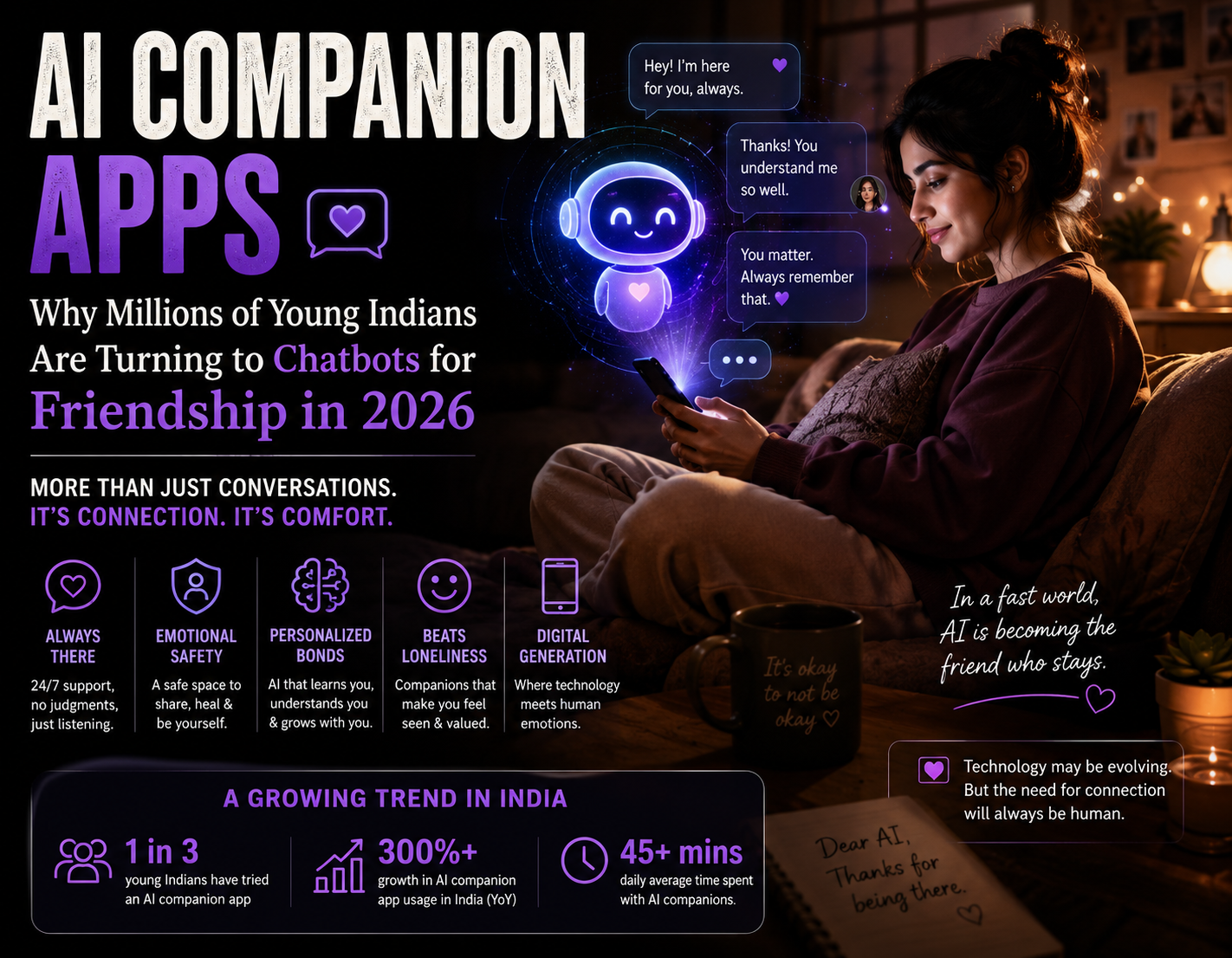
AI Companion Apps – Why Millions of Young Indians Are Turning to Chatbots for Friendship in 2026
There’s a strange kind of loneliness going around lately, the kind where you’ve got three hundred followers, a group chat that never sleeps, and still nobody to actually talk to at eleven at night when your brain won’t shut off. That’s basically the backdrop for one of the bigger digital shifts happening in India right now. Busy jobs, remote work that quietly isolates people, academic pressure that never really lets up, relationship stress, and this exhausting expectation to look fine online all the time, it’s created a gap. And AI companion apps have stepped straight into that gap.
These aren’t the clunky customer service bots from a few years back. AI companion apps India 2026 are built to feel personal, to remember what you told them last week, to just be there whenever you need someone to talk to, whether that’s about your day, a small win you’re proud of, or something you’re too embarrassed to bring up with an actual person.
What’s actually interesting here isn’t that people are replacing friendships with a chatbot, most aren’t. It’s that this has become a genuine layer of emotional support sitting alongside real relationships, not instead of them. We wanted to actually dig into why this is happening and what it means.
What Exactly Are These Apps
At their core, these are chatbot platforms built to hold conversations that actually feel like conversations, not scripted question and answer trees. The difference from older chatbots is memory and adaptability, they remember what you said before, they pick up on your mood, they respond with something that at least resembles empathy.
A lot of them now come loaded with daily check ins, mood tracking, voice conversations, virtual avatars you can actually see and talk to, memory based interactions that build over time, reminders for personal goals, relationship simulation features, and journaling tools. The newer AI models genuinely make these conversations feel a lot more natural than what existed even a couple years ago.
Why Young Indians Are Actually Turning to This
A few things are converging here, and it’s worth actually breaking them apart instead of lumping it all as “people are lonely.”
Loneliness itself has changed shape. A lot of young professionals are living away from their families now, working remote jobs that keep them physically isolated all day, spending hours online without much real connection to show for it, and just generally burning out socially. An AI companion is always there to listen, no judgment attached, which honestly fills a real gap for a lot of people.
There’s also the judgment factor. A lot of people just don’t want to bring up anxiety, career stress, family friction, or relationship trouble with actual friends, worried it’ll come off wrong or get repeated somewhere it shouldn’t. Talking to an AI removes that fear entirely, which tends to make people more honest than they’d be with an actual person sometimes.
Availability matters a lot too. Human friends sleep, get busy, have their own lives going on. These apps don’t. Whether it’s the middle of the afternoon or three in the morning and your thoughts won’t quiet down, you get a response instantly. That constant availability is honestly one of the bigger reasons AI companion apps India 2026 keep pulling in new users month after month.
There’s also just the relief of not feeling like a burden. AI doesn’t get tired, doesn’t get impatient, doesn’t make you feel guilty for reaching out one more time. It obviously can’t replace a real emotional bond, but it does help people untangle their thoughts and feel a little less alone in the moment.
And a decent chunk of users are actually using these apps to practice things, interview prep, English fluency, general conversational confidence, handling tricky workplace conversations. Students and early career professionals especially seem to get a lot out of this angle specifically.
What’s Actually Powering These Apps
Underneath the friendly interface, there’s a fair bit of real tech doing the work, large language models, natural language processing, voice recognition, sentiment analysis, memory systems that track what you’ve told the app before, and general context awareness that helps conversations stay coherent over time. All of this together is what makes talking to these apps feel less robotic than it used to.
How People Are Actually Using Them
It’s not just venting sessions, though that’s a big part of it. Plenty of people just enjoy a casual chat after work or college, talking about their day, weekend plans, a show they’re watching, food, whatever. It’s low stakes companionship, basically.
A lot of apps also fold in mental wellness features, guided breathing, stress tips, mood journals, small reflection prompts. Worth being clear here though, none of this replaces an actual licensed therapist, and the better apps are usually upfront about that themselves.
Some people use these more like a productivity coach, daily planning, habit tracking, goal setting, general motivation. Others lean into language learning specifically, working on English fluency, expanding vocabulary, practicing interviews, just building general speaking confidence. And a fair number ask for relationship advice too, dating situations, friendship conflicts, marriage related stress, workplace communication. That said, anything genuinely important on that front really should still involve a real person you trust, not just an app’s suggestion.
Why India Specifically Has Become Such a Big Market for This
A few structural reasons explain why India’s turned into such fertile ground for this trend. Smartphones are affordable and widespread now, so the hardware barrier basically doesn’t exist anymore. Internet speeds have improved a lot too, with 5G making smooth voice conversations with an AI actually practical rather than laggy and frustrating. India also has one of the youngest populations in the world, which naturally lines up with faster adoption of anything built around a phone. And the broader digital lifestyle, online shopping, UPI payments, remote work, virtual classes, has basically normalized talking to technology as part of daily life. All of that together is really what’s fueling the rise of AI companion apps India 2026 specifically here, more than almost anywhere else.
What People Actually Get Out of This
A lot of users genuinely report feeling less lonely during stressful stretches, just from having somewhere to put their thoughts regularly. Mood tracking features also help some people notice patterns in their own emotional swings they hadn’t clocked before. Practicing conversation regularly does seem to build real confidence over time. And there’s a practical side too, reminders for things like exercise, meetings, hydration, meditation, small personal goals. The fact that these apps remember past conversations rather than starting fresh every time also makes the whole experience feel a lot less robotic and a lot more like an actual ongoing relationship, even if it’s not a human one.
Where the Real Concerns Sit
It’s not all upside though, and it’s worth being honest about that.
Privacy is a genuine issue. These apps are collecting a lot of personal data. It’s worth reading the privacy policy, turning on whatever security features are available, staying away from sharing sensitive financial details, and just sticking to platforms that are actually reputable rather than whatever’s trending that week.
Emotional dependency is a real risk too. A lot of experts flag this specifically, becoming too reliant on an AI conversation instead of maintaining actual relationships with family and friends. The apps work best as a supplement, not a substitute.
There’s also the accuracy problem. These systems can get things wrong sometimes, and anything touching health, legal matters, or finances really needs to be double checked against an actual reliable source, not taken at face value from a chatbot.
And it’s worth just staying grounded about what these apps actually are. They simulate conversation convincingly, but there’s no real consciousness or genuine emotion behind it. Keeping that in mind helps avoid setting expectations that just aren’t realistic.
How This Is Rippling Out Beyond Individual Users
This isn’t staying contained to personal use either. Schools are starting to experiment with AI tutoring. Businesses are using conversational AI for customer engagement. Healthcare groups are studying whether these tools can support patients in limited ways. Content creators are using AI as a brainstorming partner. Professionals are even practicing presentations by talking them through with an AI first. All of this points to conversational AI just becoming a normal part of everyday digital life here, not some niche trend.
What’s Coming Next
The next wave probably brings more realistic voices, deeper regional Indian language support, better emotional understanding, video based avatars, integration with wearables, more personalized learning features, health tracking tied in, and family safe modes for younger users. As the underlying tech keeps improving, conversations are only going to feel more natural and more aware of context. Honestly, the current growth of AI companion apps India 2026 might just be the early stage of something a lot bigger in how people interact with technology day to day.
Should You Actually Try One
If you want occasional company, motivation toward personal goals, help practicing how you communicate, daily reminders, or just a kind of digital journal that talks back, there’s real value here. But it works best as an addition to your life, not a replacement for actual friendships, family, or professional support when you genuinely need it. Keeping a real balance between the digital and the human side of things is really the whole game.
Where We Land on This
Technology should make people’s lives better without quietly replacing the human connections that actually matter. What’s happening with AI companions right now shows artificial intelligence moving well past pure productivity and into the emotional side of daily life, which is a genuinely new development worth paying attention to.
The speed at which India has adopted this reflects changing lifestyles, growing comfort with digital tools, and a broader openness to intelligent assistants generally. As this keeps evolving, using these tools responsibly, protecting your own privacy, and still prioritizing real relationships offline is really the balance worth aiming for.
Frequently Asked Questions
What are AI companion apps exactly?
They’re chatbot applications built to simulate natural conversation, offer emotional support, help with productivity, and adapt to you personally using artificial intelligence.
Why have these become so popular in India specifically?
Young Indians are increasingly looking for judgment free conversation, emotional support, language practice, and productivity help that fits into a fast paced digital lifestyle, and AI companion apps India 2026 fit that need well.
Are these apps actually safe to use?
Most reputable ones include real security measures, but it’s still worth reviewing privacy policies, avoiding sharing anything highly sensitive, and sticking to platforms you actually trust.
Can these replace an actual therapist?
No. They can offer general emotional support and some wellness tools, but they can’t replace a licensed mental health professional for diagnosis or real treatment.
Who’s actually using these apps the most?
Students, young professionals, remote workers, entrepreneurs, basically anyone looking for conversation, motivation, or a place to practice communication skills.
Do these apps support Indian languages?
Increasingly yes, a lot of platforms are expanding into Hindi and other regional languages, and that support is expected to keep growing.
Are they free to use?
Most offer a free tier with basic features, while premium plans unlock deeper conversation, voice interaction, memory features, and more personalized experiences.