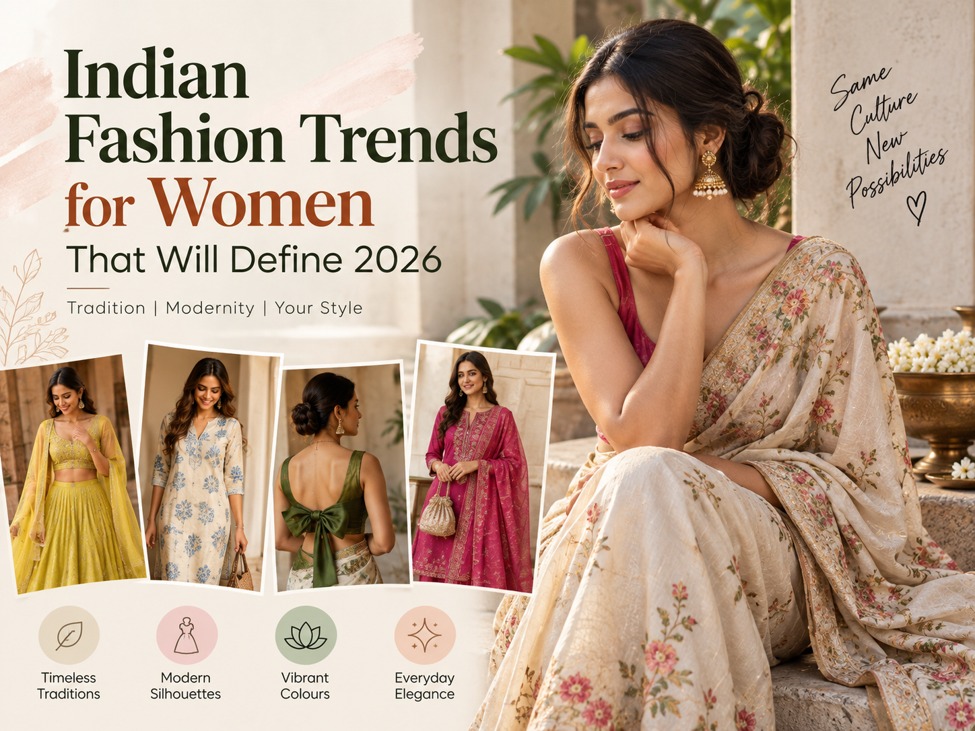
Indian Fashion Trends for Women That Will Define 2026
Indian fashion has this weird ability to reinvent itself without ever really losing itself. A sari looks completely traditional at one wedding and shows up looking totally contemporary at the next. A basic kurta goes from office to festival with just a change of accessories, nothing else needed. In 2026 that flexibility’s more visible than ever, women mixing traditional crafts with relaxed silhouettes, fusion pieces, bolder colours, and clothes that actually work for daily life.
Right now fashion coverage across India keeps circling back to reimagined saris, heritage textiles, embroidered kurta sets, bandhani, Patola, Banarasi fabric, and fusion silhouettes that don’t fit neatly into either “traditional” or “western.” Comfort still matters a lot too, especially given how warm most of the country stays most of the year.
Here’s the thing about 2026 specifically, it’s not chasing one single look. It’s taking something familiar and actually making it personal.
A few of the biggest Indian fashion trends for women 2026 that keep showing up in wardrobes right now.
- The sari’s moving past the traditional drape
Still one of the most recognisable garments India’s got, but how women wear it keeps shifting. Pre-draped saris, sari gowns, concept saris, blouse designs that barely resemble anything traditional, all giving the six-yard classic a fresh personality.
Recent celebrity styling’s leaned into corset-inspired blouses, cape-like layers, structured drapes, gown-like silhouettes. Makes the sari genuinely more approachable for women who love it but want something easier to actually style themselves.
For a wedding, a structured blouse polishes the whole look. For an evening event, pre-draped versions create a gown effect without much effort. For daytime, lightweight cotton, linen, or silk keeps things elegant without tipping into overly formal.
Sari’s not going anywhere. Just getting interpreted differently now.
- Heritage fabrics are back in a big way
One of the more encouraging shifts honestly, this renewed interest in traditional textiles and regional craft. Banarasi, Patola, Paithani, Bandhani, Kota silk, all of it showing up in contemporary wardrobes now, paired with modern cuts and simpler accessories in combinations that wouldn’t have felt right a decade ago.
Vogue India’s coverage lately has touched on Patola and Banarasi alongside Paithani and Bandhani, a good reminder that traditional craftsmanship still shapes what’s happening in Indianwear right now.
For regular shoppers this doesn’t mean an elaborate designer outfit necessarily. A handwoven dupatta, a traditional sari, an embroidered kurta, even a handcrafted bag, any of these bring heritage into an otherwise modern wardrobe.
- Fusion wear’s getting a lot more creative
Fusion’s been around a while, sure, but 2026’s bringing more interesting combinations than jeans plus kurta. Draped skirts, oversized shirts, jackets, corset-style blouses, shararas, contemporary trousers, all mixed together in ways that feel current rather than forced.
The Punjabi lacha’s had a genuine revival lately through a modern skirt-and-shirt combination, traditional roots still visible, but the styling itself feels relaxed and current.
This is honestly one of the most wearable Indian fashion trends for women 2026, mainly because it lets women mix pieces they already own instead of buying something entirely new.
Worth trying, a short kurta with wide-leg trousers, a printed dupatta over a plain dress, a draped skirt with an oversized shirt, a crop jacket layered over a simple sari, a traditional blouse with a contemporary skirt, a long kurta with straight denim.
Doesn’t need to look complicated. The best fusion outfits usually have just one traditional element and one modern one, not five competing ideas at once.
- Relaxed kurta sets are holding strong
Not everything needs drama. For working women, students, anyone travelling, kurta sets remain genuinely practical. Loose silhouettes, breathable fabric, subtle embroidery, works for office meetings and family lunches equally well.
Celebrity looks lately have leaned back into embroidered kurta sets too, hand embroidery, silk fabric, colourful threadwork adding character without piling on heavy embellishment.
Expect more play with length and proportion this year. Straight kurtas with wide trousers, shorter kurtas with skirts, longer flowing ones paired with minimal jewellery instead of a lot.
- Comfortable fabric matters more than ever
India’s weather genuinely dictates a lot of clothing choices. Through summer, breathable fabric, cotton, linen, chanderi, lightweight silk, makes a real difference. Current coverage keeps circling back to breathable kurtas, kaftans, lightweight festive clothing built for warmer months specifically.
This is really where fashion and practicality actually meet. A beautiful outfit’s not worth much if it’s unbearable after twenty minutes outdoors. Women increasingly want clothes that move with them and still look put together.
For daytime, consider cotton kurtas, linen saris, chanderi sets, lightweight cotton dresses, relaxed kaftans, soft organza dupattas. Comfort doesn’t have to mean boring either, fabric, colour, and accessories still carry plenty of personality on their own.
- Bandhani’s moving past wedding wear
Traditionally tied to Rajasthan and Gujarat, weddings, festive occasions specifically. Designers are pushing it into more everyday fashion now though. Bandhani co-ords, dresses, other modern pieces, letting the tie-dye technique reach people well beyond ceremonial dressing.
Genuinely exciting shift, honestly, shows how Indian crafts can stay relevant without staying locked to one type of outfit. A Bandhani dupatta over a plain kurta is an easy entry point. Bolder dressers can push into Bandhani skirts, dresses, or full coordinated sets.
- Softer colours are finding real space
Rich reds, emeralds, royal blues, pinks, always going to have their place in Indian fashion. But softer shades are becoming a lot more versatile lately. Butter yellow, pastel pink, sage green, cream, powder blue, muted peach, all working well for daytime and summer celebrations specifically.
Butter yellow especially has shown up across saris, lehengas, coordinated outfits, western-inspired pieces throughout 2026.
The real advantage with softer colours, they dress up or down easily. A pastel kurta with pearl earrings makes a delicate daytime look. The exact same shade in silk with statement jewellery works fine for an evening event too.
- Statement blouses are changing the whole sari game
Sometimes updating a sari’s as simple as swapping the blouse. This year women are pushing into halter necks, strapless-inspired designs, structured corsets, cap sleeves, dramatic backs, contemporary cuts.
Recent coverage’s highlighted modern sari styling built around strapless and halter blouse designs specifically. Obviously the right blouse depends on occasion and personal comfort, but a simple sari with a distinctive blouse often reads more modern than something covered head to toe in embellishment.
- Traditional jewellery’s being styled differently
Jewellery still matters a lot in Indian dressing, but a full traditional set isn’t always necessary anymore. A pair of jhumkas with a contemporary dress creates real contrast. Stacked bangles work fine with a simple kurta. One statement necklace becomes the whole centrepiece of a minimal sari.
Polki, kundan, pearls, silver, colourful gemstones, all still showing up across Indian occasionwear. Real trend here, mixing rather than matching everything perfectly. Sometimes one statement piece genuinely is enough.
- Retro details are making a return
Fashion rarely moves in a straight line, styles from earlier decades keep circling back with a fresh spin. In Indianwear that shows up through cap sleeves, classic sari drapes, traditional borders, vintage-inspired jewellery, silhouettes clearly pulled from earlier eras.
Recent styling’s shown a real pull toward 1990s-inspired sari blouse details specifically. Trick here, don’t turn the whole outfit into a costume from another decade. One retro element paired with contemporary pieces usually lands better.
- Everyday ethnic wear’s getting more versatile
Indian fashion isn’t just weddings and festivals anymore. Women are building wardrobes around pieces that pull double or triple duty. A simple embroidered kurta works with trousers for the office, with a dupatta for a family dinner, with jewellery and heels for something festive.
That kind of versatility makes fashion a lot more practical, and honestly encourages buying fewer pieces that actually get worn regularly instead of sitting in the closet.
A genuinely useful wardrobe might include one versatile cotton kurta, a neutral straight pant, a colourful dupatta, one lightweight sari, a comfortable co-ord set, a statement blouse, a pair of traditional earrings, and one festive outfit held back for special occasions. Doesn’t take a huge wardrobe to actually experiment.
- Personal style matters more than chasing every trend
Maybe the biggest takeaway from Indian fashion trends for women 2026, there isn’t one single correct way to dress. Fashion’s genuinely becoming more individual.
Some women lean toward a heavily embroidered lehenga. Others prefer a simple cotton sari. Someone else feels most like themselves in an oversized kurta and trousers. Social media makes trends look universal, but real wardrobes are a lot more personal than any feed suggests.
Instead of buying something purely because it’s trending, worth asking three honest questions. Will I actually wear this? Is it comfortable for me specifically? Does it actually feel like my style? If yes across the board, the trend’s genuinely useful. If not, no reason to force it into the closet.
How to make 2026 trends actually work for you
No need to replace an entire wardrobe every season, genuinely. Start small instead. Add a colourful dupatta to something you already own. Try a new blouse with an old sari. Wear traditional earrings with western clothing. Play with a different silhouette. Pick a heritage fabric for your next occasion outfit.
Small changes like these make familiar clothes feel new again without spending much. For anyone who loves experimenting, 2026’s got plenty of room to play with texture, colour, proportion, traditional craft. For anyone who prefers classic dressing, the same trends adapt in subtler ways too.
That’s honestly what makes Indian fashion so interesting, tradition and modernity genuinely coexisting in the same wardrobe without one cancelling the other out.
About New Indian Statement
New Indian Statement is a digital platform built around bringing readers informative, engaging stories across a range of subjects. Lifestyle, fashion, society, culture, everyday interests, the goal’s always accessible, easy-to-follow content.
Fashion carries real weight in India’s cultural identity, and covering how it shifts offers a way to look at more than just clothes, it reflects changing lifestyles, regional craftsmanship, creativity, and how a new generation’s reinterpreting traditional ideas.
Frequently asked questions (FAQs) FAQs
What are the biggest Indian fashion trends for women in 2026?
Modern saris, heritage textiles, fusion wear, relaxed kurta sets, contemporary blouses, traditional jewellery, and versatile ethnic clothing are the main directions showing up in Indian fashion coverage this year.
Are traditional Indian fabrics still fashionable in 2026?
Yes, genuinely. Banarasi, Patola, Paithani, Bandhani, and Kota silk keep appearing in contemporary fashion, increasingly styled alongside modern silhouettes rather than kept separate.
What should women wear for a casual Indian look?
A comfortable kurta with straight or wide-leg trousers is an easy default. A simple co-ord set, a cotton dress with traditional jewellery, or a kurta paired with denim all work well too.
Are saris still popular in 2026?
Yes. Coverage keeps featuring both traditional and contemporary styles, pre-draped saris, concept saris, sari gowns, modern blouse designs, all still going strong.
What colours are trending in women’s fashion in 2026?
Pretty broad palette honestly, softer shades like butter yellow, pastel pink, cream, and muted greens are showing up alongside traditional reds, pinks, mustard, and jewel tones.
How can I follow fashion trends without spending too much?
Update existing clothes instead of buying an entirely new wardrobe, accessories, dupattas, jewellery, footwear, a new blouse. Mixing older pieces with one or two newer additions creates a fresh look fast.
Is fusion wear suitable for formal occasions?
Yes, depending on the event. A draped skirt with an embellished blouse, a structured kurta set, a sari with a contemporary blouse, or traditional textile paired with modern tailoring all work well formally too.
Final thoughts
The most interesting part of Indian fashion trends for women 2026 is genuinely that balance between old and new. Traditional textiles getting fresh silhouettes. The sari being reimagined constantly. Bandhani finding space outside ceremonial dressing entirely. Kurta sets becoming more versatile, contemporary jewellery and modern blouses changing familiar outfits in small but real ways.
Trends only matter when they actually work for the person wearing them though. Whether your style leans minimal, traditional, experimental, or somewhere in between, this year offers plenty of room to play. Choose colours you genuinely enjoy, wear fabric that feels comfortable, experiment with silhouettes that suit you, and let personal style stay the most important part of any outfit.
The best fashion trend, honestly, is just the one that lets you feel comfortable enough to actually be yourself.