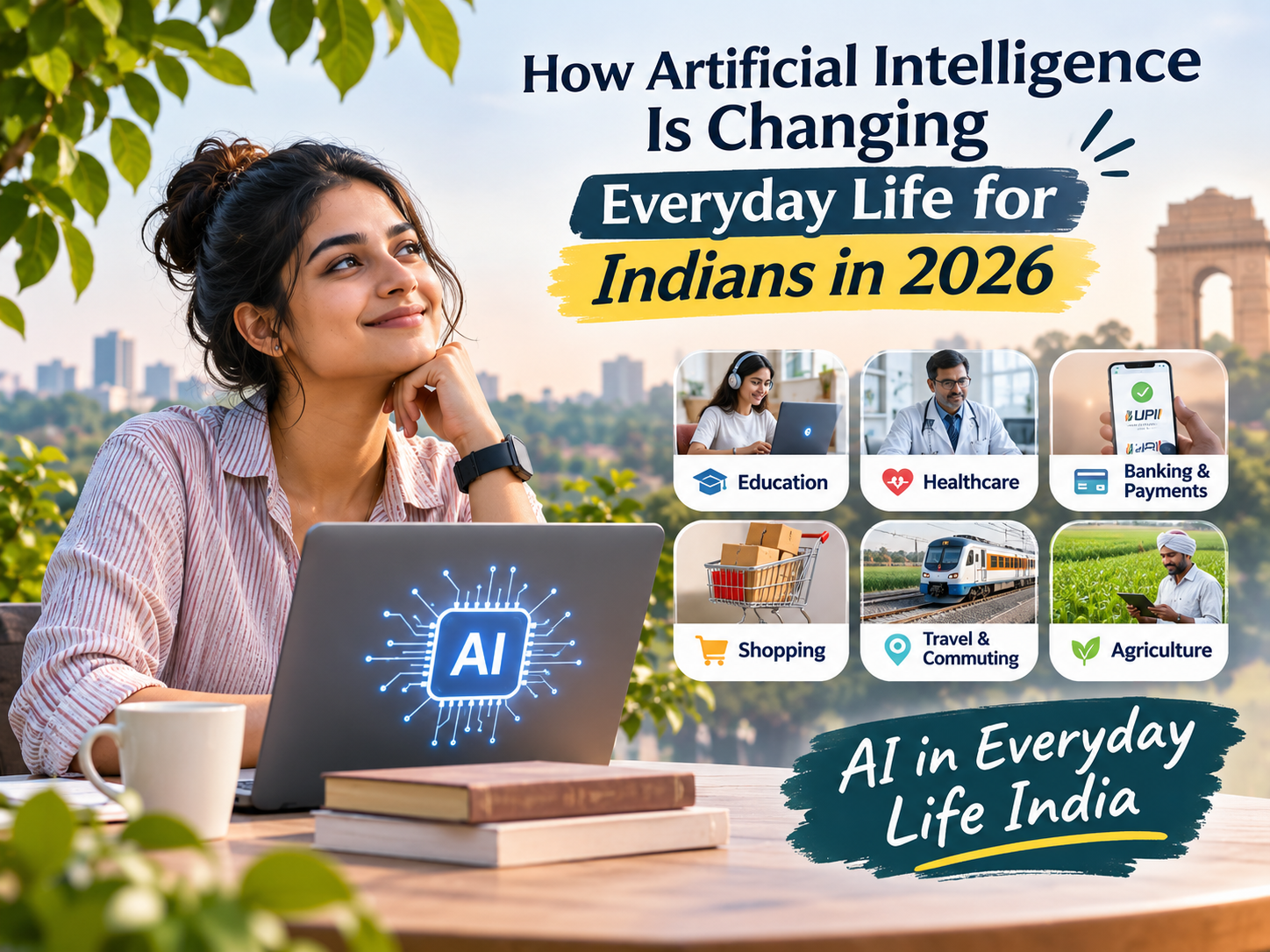
How Artificial Intelligence Is Changing Everyday Life for Indians in 2026
A few years ago, artificial intelligence sounded like something that belonged in science fiction movies or advanced technology laboratories. Today, it has quietly become part of everyday conversations and activities. From asking a chatbot to write an email to using a mobile application for travel directions, Indians are interacting with AI more often than they may realise.
In 2026, technology is changing the way people study, work, shop, communicate and manage their daily responsibilities. A student can understand a difficult subject with the help of an AI tool, while a small business owner can use technology to create marketing content without hiring a large team.
The growing presence of AI in everyday life India is not limited to people working in the technology industry. It is reaching students, homemakers, professionals, business owners, farmers and even people living in smaller towns.
What makes this development interesting is that many people are using artificial intelligence without thinking too much about the technology behind it. They simply want something that saves time, makes a task easier or helps them find better information.
But how much is AI actually changing ordinary Indian life? Let’s explore.
1. Education Is Becoming More Personalised
Education is one of the areas where artificial intelligence is making a noticeable difference. Traditionally, students depended on textbooks, classroom teaching and additional tuition to understand difficult subjects.
Today, AI-powered learning tools offer another way to approach education.
Students can ask questions, receive explanations in simpler language, practise grammar, generate revision notes and understand complicated topics through examples. Someone preparing for competitive examinations can use AI tools to organise study schedules and practise questions.
For students in smaller cities and towns, these tools can provide additional learning support, especially when access to individual tutoring is limited.
However, there is an important distinction between learning with AI and depending entirely on it. Students still need to develop their own thinking, research and problem-solving abilities.
Used properly, AI can act like an additional learning assistant rather than a replacement for teachers.
2. Healthcare Is Getting More Technology-Driven
Healthcare is another sector where artificial intelligence is creating new possibilities.
AI-powered systems can help medical professionals analyse medical images, identify patterns in patient information and support certain diagnostic processes. Hospitals and healthcare organisations are also exploring AI for appointment management, patient communication and administrative work.
For ordinary people, health applications can provide general wellness information, medication reminders and support with organising health records.
In India, where access to healthcare professionals can vary significantly between urban and rural areas, technology may help improve access to certain healthcare services.
However, AI should not be treated as a doctor. A chatbot cannot replace a physical examination, professional diagnosis or emergency medical care. People should always consult qualified healthcare professionals before making important medical decisions.
The real opportunity is to use technology to support healthcare workers and make healthcare services more accessible.
3. Banking and Digital Payments Are Becoming Smarter
India has experienced a major transformation in digital payments over the last few years. UPI has made it possible for people to transfer money, pay shopkeepers and manage everyday transactions using their smartphones.
Artificial intelligence is adding another layer to the digital financial ecosystem.
Banks and financial institutions use AI-based systems to identify unusual transaction patterns, support fraud detection, improve customer service and analyse financial activity.
For customers, this can mean faster responses to routine banking queries and additional security checks when suspicious activity is detected.
AI-powered chatbots are also helping customers find answers about account services, card-related queries and other basic banking matters.
Still, people need to remain careful. Fraudsters can also misuse AI to create convincing messages, fake calls and misleading financial offers. Never share OTPs, passwords or banking details with unknown callers or links.
4. Shopping Experiences Are Becoming More Personal
Online shopping has become a regular habit for many Indian households. Whether someone is buying clothes, groceries, electronic products or household essentials, digital platforms have changed how people discover products.
AI plays an important role in these shopping experiences.
Have you ever noticed how an online shopping application recommends products based on what you previously searched for? Or how a platform suggests similar products after you view a particular item?
These recommendations are often supported by AI and machine learning systems.
Businesses also use AI to understand customer preferences, improve product searches, manage inventory and provide automated customer support.
For small online sellers, AI tools can help prepare product descriptions, organise catalogues and create promotional content.
However, personalised recommendations can sometimes encourage unnecessary spending. Customers should compare prices, read genuine reviews and purchase products based on actual requirements rather than recommendations alone.
5. Travel and Daily Commuting Are Becoming Easier
Travelling in Indian cities can be challenging, especially during peak traffic hours. Finding the right route, estimating journey time and identifying public transport options are everyday concerns.
AI-powered navigation systems help analyse traffic patterns and suggest alternative routes. These systems use information from multiple sources to provide updated travel recommendations.
Travel platforms also use intelligent systems to suggest destinations, personalise hotel recommendations and support customer queries.
For people travelling between cities, these tools can make planning more convenient.
Even local businesses such as restaurants, hotels and travel operators are using AI-powered solutions to manage customer enquiries and improve online communication.
The benefit is simple: people can spend less time organising routine travel details and more time enjoying their journeys.
6. Small Businesses Are Getting Access to Powerful Tools
One of the most interesting changes is happening among small businesses and independent entrepreneurs.
Earlier, creating professional marketing content, designing advertisements, analysing customer behaviour and managing digital communication often required dedicated employees or external agencies.
Now, AI tools are making some of these activities more accessible.
A local clothing store can use AI to generate product descriptions. A restaurant owner can prepare social media captions. A freelancer can organise client emails, while a small business can use AI-powered chatbots to answer common customer questions.
This development is particularly relevant in India, where small businesses and local entrepreneurs play an important role in the economy.
The growing use of AI in everyday life India is helping businesses explore digital opportunities that were previously difficult or expensive to access.
However, AI-generated content still needs human review. Customers value genuine communication, and businesses must ensure that the information they publish is accurate and relevant.
7. Indian Languages Are Becoming More Important in Technology
India’s linguistic diversity creates a unique challenge for digital services. Millions of people are more comfortable communicating in Hindi, Punjabi, Tamil, Bengali, Marathi and other regional languages than in English.
AI-powered translation, speech recognition and voice-based technologies are helping address this gap.
People can now use voice commands, translate text and interact with certain digital services in languages they understand better.
Initiatives such as BHASHINI are also working towards making digital services more accessible through Indian languages.
This is an important development because technology should not be available only to people who are comfortable using English.
If AI tools become more accurate across Indian languages, they could help more people access educational resources, government information and digital services.
8. Agriculture Is Exploring New Technology
Agriculture remains an important part of India’s economy, and farmers face several challenges, including changing weather conditions, crop diseases, irrigation requirements and market uncertainty.
Artificial intelligence offers potential support in addressing some of these problems.
AI-based agricultural solutions can analyse weather information, satellite images and crop data to help identify patterns. Certain applications can also help detect crop diseases through photographs and provide information about farming practices.
Farmers may use digital platforms to access weather updates, market information and agricultural guidance.
However, technology alone cannot solve every agricultural challenge. Internet access, affordability, local language support and the accuracy of recommendations remain important considerations.
The aim should be to combine traditional agricultural knowledge with useful modern tools.
9. The Growing Concern Around Privacy and Misinformation
While AI offers several benefits, its rapid growth also raises important questions.
One major concern is personal data privacy. Many AI-powered applications process information provided by users. People should understand what data an application collects and how that information may be used.
Another concern is misinformation. AI can generate realistic-looking images, videos, voices and written content. Some of these creations can be used to mislead people or spread false information.
Deepfake videos and fake voice recordings are particularly concerning because they can make false claims appear genuine.
This makes digital awareness more important than ever.
Before forwarding a message, believing a viral video or sharing personal information, people should verify the source. Technology can make information available quickly, but it cannot guarantee that everything online is true.
10. Will AI Replace Human Jobs in India?
This is perhaps the question that concerns many working professionals.
Artificial intelligence can automate repetitive tasks such as basic data entry, content formatting, customer query handling and certain administrative activities. As businesses adopt these tools, some traditional job responsibilities may change.
At the same time, new opportunities are developing in areas such as AI development, data analysis, automation, cybersecurity and technology management.
Many existing professionals may also need to learn how to work alongside AI tools.
For example, a marketer can use AI to analyse information and prepare content ideas, but understanding customer behaviour, developing a brand strategy and making creative decisions still require human judgement.
Rather than assuming that AI will replace every job, it is more useful to understand which skills are becoming important.
Communication, critical thinking, creativity, adaptability and technical knowledge will remain valuable in an increasingly technology-driven workplace.
Frequently Asked Questions (FAQs)
1. How is AI changing everyday life in India in 2026?
AI is helping people with education, healthcare support, online shopping, banking, travel planning, communication and business activities. It is making several routine tasks faster and more convenient.
2. What are some common examples of AI used by Indians?
Common examples include AI chatbots, voice assistants, Google Maps traffic predictions, personalised shopping recommendations, spam detection, translation applications and AI-powered customer support.
3. Is artificial intelligence useful for students in India?
Yes. Students can use AI for explanations, language practice, revision notes, research assistance and learning support. However, they should verify information and avoid depending entirely on generated answers.
4. Can AI help small businesses in India?
Yes. Small businesses can use AI for content creation, customer communication, product descriptions, marketing research and basic business automation. Human review remains important to maintain quality and accuracy.
5. Is AI safe to use for everyday activities?
AI tools can be useful, but users should avoid sharing sensitive personal information, banking details and passwords. They should also verify important information before acting on AI-generated recommendations.
6. Will artificial intelligence replace jobs in India?
AI may automate certain tasks and change existing job roles, but it can also create new opportunities. Learning digital skills, problem-solving and AI-related tools can help professionals adapt.
Final Thoughts
Artificial intelligence is no longer a technology that people only read about in newspapers or see in science fiction films. It is becoming part of ordinary Indian life, influencing how people learn, work, communicate, shop and make decisions.
The growing presence of AI in everyday life India brings both opportunities and responsibilities. While technology can save time and make information more accessible, people must also understand its limitations.
The most important thing is not to use AI for everything but to understand where it can genuinely make life easier.
At New Indian Statement, we believe that technology is more than just machines, applications and new inventions. It is also about how these developments influence society, individual choices and the future of everyday living.
Through our articles, we aim to bring readers closer to the changing stories of modern India, covering lifestyle, technology, culture and emerging trends.
As India moves towards a more digitally connected future, one thing is certain: artificial intelligence will continue to evolve, but human judgement, creativity and curiosity will remain essential.