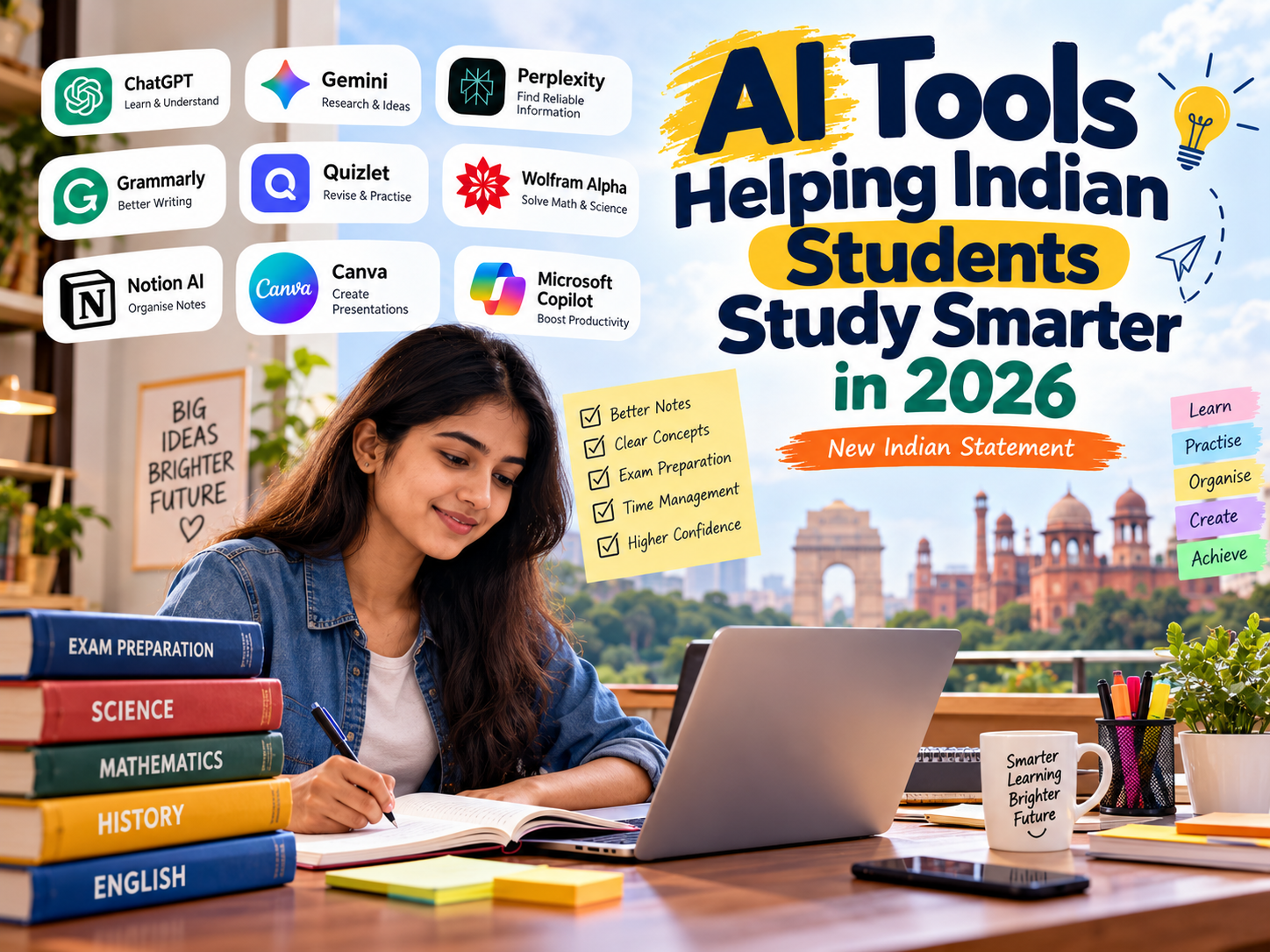
AI Tools Helping Indian Students Study Smarter in 2026
Studying today looks very different from how it did a few years ago. Students once depended mainly on textbooks, classroom notes, library visits, and help from teachers to understand difficult subjects. These resources are still important, but technology has introduced new ways to learn, practise, and prepare for exams.
In 2026, artificial intelligence is becoming a useful part of the student experience. From explaining complicated concepts in simple language to helping organise revision schedules, AI-powered applications can make everyday studying more manageable. Students preparing for board examinations, competitive tests, college assignments, or professional courses can use these tools to approach their studies with greater confidence.
The growing popularity of AI tools for students in India reflects a wider change in education. Students want flexible learning support, quick explanations, and practical ways to manage their workload, particularly when balancing school, college, coaching classes, and personal commitments.
However, using AI effectively is not simply about finding answers quickly. The real advantage comes from understanding concepts, practising independently, and learning how to identify mistakes.
Here are some useful AI tools, their practical applications, and ways Indian students can use them responsibly to improve their learning experience.
1. ChatGPT for Understanding Difficult Subjects
ChatGPT can be a helpful study companion for students who need explanations, examples, practice questions, or assistance organising their notes.
Imagine a student struggling to understand a physics concept or a complicated economics chapter. Instead of reading the same paragraph repeatedly, the student can ask ChatGPT to explain the topic in simpler language, provide a real-life example, or break the concept into smaller steps.
It can also help with grammar, essay outlines, revision questions, and practice exercises across different subjects.
For example, a student preparing for a history examination could ask for a timeline of important events. Someone learning mathematics could request a step-by-step explanation of a problem and then attempt similar questions independently.
The best way to use ChatGPT is to treat it like a patient tutor rather than a shortcut to completing assignments. Students should try solving problems themselves, ask follow-up questions when something is unclear, and verify important facts against textbooks or reliable educational sources.
AI can make difficult topics easier to approach, but genuine learning still requires practice and independent thinking.
2. Google Gemini for Research and Study Support
Google Gemini can help students explore unfamiliar subjects, organise ideas, and work through questions that require explanation or brainstorming.
A student preparing a school project might use it to develop an outline, identify research questions, or understand the background of a particular topic. College students can use it to explore concepts before reading academic material in greater depth.
Depending on the available features and subscription, Gemini may also work with supported Google Workspace applications, helping students organise documents and other study materials.
For instance, a student preparing a presentation on renewable energy could ask for a logical structure covering solar power, wind energy, environmental benefits, and practical challenges. The student can then research the subject, confirm the information, and prepare the final presentation independently.
When using AI for research, it is important to distinguish between a suggested explanation and a verified fact. Students should check original sources, especially when working on academic assignments that require accurate statistics or references.
Gemini can help organise the research process, but it should not replace the habit of reading credible material.
3. Perplexity for Finding Information Online
Searching the internet for an assignment can quickly become confusing. A simple question may produce hundreds of pages, and not every website offers reliable or relevant information.
Perplexity is an AI-powered search and answer tool that provides responses with linked sources. It can help students explore a topic, identify potentially useful references, and find directions for further research.
For example, a commerce student studying India’s digital economy could use it to discover relevant reports, articles, and official resources. A science student could explore a subject before consulting textbooks or academic publications.
One of its useful features is the ability to move from a general question towards more specific research.
However, students should open the cited sources rather than relying only on the generated summary. They should check publication dates, author credentials, and whether the information actually supports the claim being made.
This is especially important for assignments that require academic references, recent data, or evidence from official sources.
4. Grammarly for Better English Writing
Good writing is essential for school assignments, college essays, applications, presentations, and professional communication. Yet many students struggle with grammar, sentence structure, spelling, and expressing their ideas clearly in English.
Grammarly can help identify writing issues and suggest improvements to grammar, punctuation, clarity, and tone. Its available AI features may also assist with rewriting and drafting.
For an Indian student studying in English, the tool can be useful when preparing an essay or reviewing an application letter. It can highlight unclear sentences and offer alternatives that are easier to understand.
Students should not accept every suggestion automatically. Sometimes a tool may change the intended meaning or make a simple sentence unnecessarily formal.
A useful habit is to write the first draft independently, review the suggested corrections, and understand why changes are recommended. This helps students improve their own writing skills rather than depending entirely on automated corrections.
Over time, this approach can make writing assignments less stressful and help students communicate their ideas more confidently.
5. Quizlet for Revision and Active Recall
Reading a chapter several times does not always mean the information will be remembered during an examination. Students often benefit from testing themselves rather than simply reviewing the same material.
Quizlet provides digital flashcards, practice activities, and study tools that can help students revise definitions, vocabulary, formulas, and important facts. Some features use AI to support the creation of study materials, depending on the current plan and availability.
For example, a biology student can create flashcards for cell structures, while someone preparing for a language examination can practise vocabulary and meanings.
Students can also turn their own notes into questions and answers, making revision more interactive.
The main benefit is active recall: trying to retrieve information from memory rather than just recognising it on a page. Reviewing difficult questions again after a suitable interval can also support long-term retention.
Students should check AI-generated flashcards for accuracy, especially when studying technical subjects where small mistakes can lead to confusion.
6. Wolfram Alpha for Mathematics and Scientific Problems
Mathematics can become frustrating when students understand the theory but struggle to check their calculations or work through unfamiliar problems.
Wolfram Alpha is a computational knowledge tool that can help with mathematical calculations, equations, graphs, and selected scientific problems. Some advanced capabilities and detailed solution steps may require a paid plan.
Students can use it to check algebraic expressions, explore functions, investigate mathematical relationships, or verify answers to practice problems.
For example, a student studying calculus might use the tool to check a derivative after attempting the problem manually. A physics student could verify a calculation involving units or mathematical expressions.
The important point is to avoid copying an answer without understanding the method. Students should first attempt the question, compare the result, and identify any errors in their reasoning.
When used this way, computational tools can provide feedback and help students develop stronger problem-solving habits.
7. Notion AI for Organising Notes and Study Schedules
Many students have notes scattered across notebooks, PDFs, messaging applications, and different folders on their devices. Finding the right material before an examination can become a challenge.
Notion provides a workspace for notes, documents, databases, and task management. Its AI features can assist with summarising content, organising information, and preparing initial drafts.
Students can create separate pages for each subject, maintain assignment deadlines, record important questions, and build a revision timetable.
For example, a college student preparing for semester examinations could organise notes by subject and chapter. A study tracker could show which topics are complete, which need revision, and which require additional practice.
Notion AI may help turn rough notes into clearer summaries, but students should compare these summaries with their original material to avoid missing important details.
The most effective system is one that remains simple enough to use every day. A complicated study planner is unlikely to help if maintaining it becomes another time-consuming task.
8. Canva for Presentations and Visual Learning
Not every student learns best by reading long paragraphs. Diagrams, timelines, flowcharts, and visual summaries can make some subjects easier to understand.
Canva offers design templates and AI-supported features for creating presentations, infographics, study posters, and other educational materials.
A student preparing a geography project can create a visual explanation of climate patterns. Someone studying history can develop a timeline of important events, while a college student can use presentation templates to organise a seminar.
Visual learning materials can also be useful for personal revision. A carefully designed mind map may help a student connect concepts that appear unrelated when presented in separate textbook sections.
However, attractive design should not become more important than accurate content. Students need to verify facts, review labels, and make sure the visuals genuinely explain the subject.
Canva can simplify the design process, leaving more time for research and understanding.
9. Microsoft Copilot for Documents and Productivity
Students who use Microsoft Word, PowerPoint, Excel, and other supported Microsoft applications may find Microsoft Copilot useful for certain academic tasks.
Depending on the available plan and features, it can assist with drafting documents, summarising material, exploring spreadsheet data, and preparing presentation outlines.
For example, a college student could use AI assistance to structure a report before adding research and original analysis. A student working on a group project might use a spreadsheet to organise survey results and explore patterns in the collected data.
It can also help students develop an initial presentation structure, although the final content should reflect their own understanding and meet their institution’s academic requirements.
Students should check whether the relevant features are included in their account before relying on them.
Used thoughtfully, Copilot can reduce time spent on document formatting and organisation, allowing students to concentrate on the academic work itself.
10. AI Tools for Students in India: How to Choose the Right Ones
There is no need to install every popular AI application. The right choice depends on the subject, learning style, budget, and task.
Here is a simple guide:
- For explanations and brainstorming: ChatGPT or Google Gemini.
- For online research: Perplexity.
- For English writing: Grammarly.
- For flashcards and revision: Quizlet.
- For mathematics and calculations: Wolfram Alpha.
- For notes and study planning: Notion AI.
- For presentations and visual summaries: Canva.
- For documents and productivity: Microsoft Copilot.
These tools offer different capabilities, and free access, paid features, and usage limits can change. Students should check official websites before subscribing.
The smartest approach is to choose one or two tools that solve a genuine study problem. Test them for a few weeks and evaluate whether they improve understanding or save time without creating extra distractions.
For students exploring AI tools for students in India, affordability, accessibility, language support, and compatibility with existing devices are also important considerations.
11. How Indian Students Can Use AI Responsibly
AI can make learning more convenient, but it also creates a risk of becoming too dependent on ready-made answers.
Students can avoid this by following a few practical habits.
Attempt the task first. Try solving a problem or writing an answer before asking AI for help. This makes it easier to identify the exact point of confusion.
Ask for explanations, not just answers. Request examples, step-by-step reasoning, practice questions, and feedback on your approach.
Verify important information. Check facts, formulas, quotations, and references using textbooks, teachers, official sources, or trusted academic materials.
Follow academic rules. Some schools and universities restrict AI-generated work or require students to disclose its use. Always follow the relevant policy.
Protect personal information. Avoid uploading private documents, identification details, passwords, or confidential academic records to AI platforms without proper authorisation.
Keep practising independently. Examinations often require students to solve problems without digital assistance. Regular independent practice remains essential.
AI should make students more capable, not more dependent. The goal is to understand a subject well enough to explain it and apply it without needing a tool to provide every answer.
How New Indian Statement Connects with Education and Technology
New Indian Statement can help readers understand how technology is changing education and creating new opportunities for students across India.
AI in education is not only about new applications. It also raises important questions about learning quality, digital access, affordability, academic honesty, and the skills students will need in the future.
Through accessible articles on educational technology, digital learning, student life, and emerging trends, New Indian Statement can help students and families make more informed decisions.
Practical coverage can explain what different tools do, where they are useful, and when traditional learning methods remain essential. This balanced approach is particularly important for students who are still developing their research, writing, and problem-solving skills.
By focusing on realistic examples rather than exaggerated promises, New Indian Statement can make technology-related information more useful for students, parents, and educators.
Conclusion
AI is creating new ways for students to understand subjects, practise skills, organise assignments, and prepare for examinations. Tools such as ChatGPT, Gemini, Grammarly, Quizlet, and Wolfram Alpha can support different parts of the learning process when used appropriately.
However, better studying is not about finding the fastest shortcut. It is about understanding concepts, remembering information, asking good questions, and learning how to solve problems independently.
Students exploring AI tools for students in India should begin with their own needs, select suitable applications, and check whether the tools genuinely improve their learning experience.
AI can explain a difficult topic or suggest a revision plan, but curiosity, consistency, and independent effort remain essential.
For New Indian Statement, this is an opportunity to make educational technology easier to understand and help young readers prepare for a future in which digital skills and sound judgement will matter together.
Frequently Asked Questions (FAQs)
1. What are the best AI tools for students in India in 2026?
ChatGPT, Google Gemini, Perplexity, Grammarly, Quizlet, Wolfram Alpha, Notion AI, Canva, and Microsoft Copilot are useful options for different learning needs. The best choice depends on the subject, budget, and available features.
2. Can AI tools help students prepare for competitive examinations?
Yes. Students can use AI to explain concepts, generate practice questions, organise revision schedules, and clarify difficult topics. Exam-specific preparation should still rely on the official syllabus, reliable study materials, and independent practice.
3. Are AI study tools free for Indian students?
Some tools offer free versions, while advanced features may require paid subscriptions. Pricing and usage limits can change, so students should check current details before purchasing a plan.
4. Can AI tools explain difficult subjects in simple language?
Yes. Many AI assistants can provide simplified explanations, examples, and step-by-step guidance. Students should ask follow-up questions and verify important information with trusted educational resources.
5. Is it acceptable to use AI for school and college assignments?
It depends on the institution’s academic integrity policy and the assignment requirements. AI may be permitted for brainstorming or editing but restricted for producing submitted work. Students should follow their institution’s rules and disclose AI use when required.
6. Can AI replace teachers or tutors?
AI can provide explanations and practice support, but it cannot fully replace a teacher’s understanding of a student’s progress, classroom context, and individual learning needs. Teachers remain important for guidance, feedback, and encouragement.
7. How can students avoid becoming dependent on AI?
Students should attempt questions independently, use AI to understand mistakes, verify information, and practise without digital assistance. Regular revision and problem-solving remain essential for lasting learning.
8. How does New Indian Statement help students understand educational technology?
New Indian Statement can publish practical articles about AI applications, digital learning, educational trends, and responsible technology use. This helps students and families explore new tools while understanding their benefits and limitations.