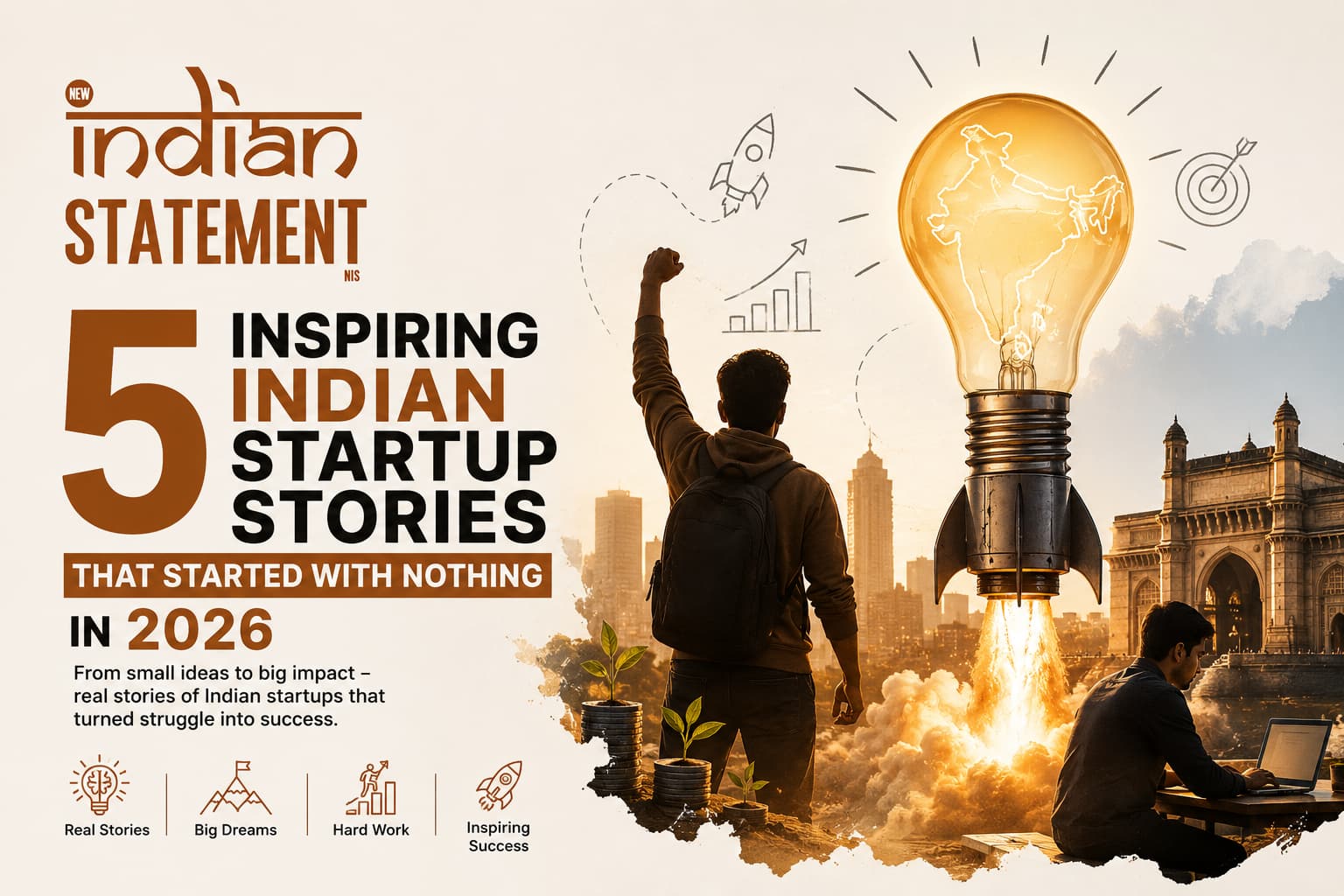
5 Inspiring Indian Startup Stories That Started With Nothing in 2026
Relationships & Personal Growth By New_Indian_StatementIndia’s startup ecosystem is churning out extraordinary success stories. 2026 is the year when many founders showed that you can build a challenging business without fundraising, fancy office spaces or being from a wealthy background. From small towns or working out of their houses, or building companies while subsisting on ramen for 5 years.
These 2026 Indian startup success examples demonstrate how you need creativity to complete your dreams with purpose and tenacity. These stories are inspiring people everywhere whether it is bootstrapped startup India 2026 examples or founders solving real-world problems.
Startup Success Stories 2026:
It all starts with a brilliant idea, well, almost. Most individuals see the end success but do not witness the struggle behind it. And this journey comes with long hours of work, struggling to find the money, being beaten by the market and personal sacrifices.
These are stories of founders who never gave up. They are a reflection of India’s entrepreneurship culture, where millions of others with different backgrounds are already making things happen for themselves and for the economy.
Karsanbhai Patel: The man who grew Nirma from his backyard
One of the most inspirational business success stories in India is that of Karsanbhai Patel. He worked with a laboratory in Gujarat as a technician for a very low salary before becoming an entrepreneur. He noticed that there was a need for affordable detergent powders available in the market and most of the detergent powders were expensive for many middle-class families, especially during the 70s. His inspiration came primarily from this void, which ultimately led him to create something life-changing.
Patel started manufacturing detergent powder by using a few pieces of equipment at his home after finishing his regular office work in the evening. He personally assembled the product and went from house to house selling it on a bicycle. It was tough to earn trust, since customers came with familiarity with the big brands. Perhaps this is due to the absence of investors and a limited budget which made him depend only on pricing, as well as, word of entourage promotion.
Nirma grew across Gujarat as demand grew and then further across India. The reason the brand really took off is that it gave families a decent product at a price point that was realistic for the average family. Nirma was a company that continued to grow momentum through value and accessibility, even as multinationals entered the market.
Nirma is kept as one of the first few examples to understand brand building and in no time, today Nirma itself is one of the well-known consumer products companies in India. The billion-dollar behemoth you see today began in a tiny backyard destined to become a testament of the power of Indian entrepreneurship.
Sridhar Vembu: Creating Zoho With No External Funding
Sridhar Vembu was born and raised in a middle-class family in Tamil Nadu and believed that India could build world-class software products. When entrepreneurs were scrambling for investors, he went another way. He sought to create a company that could scale via its own profits rather than needing capital from outside sources.
Zoho has faced a few challenges in the past. The company was operating on a shoestring and competing against long-established international software firms. Back in the days when Indian software product companies had not yet become household names with global customers, it was a hard job to build that trust.
Vembu decided not to focus all operations on big cities, but ventured into handholding small and rural areas. It brought down costs and created jobs not just in traditional tech hubs. As Zoho gradually expanded software offerings, it pulled in global businesses.
Today Zoho has over 180 countries of customers and is into Sales, Accounting, Communication, Collaboration and Business Apps. It is still privately owned and profitable, which shows that some global potential exists without all of the venture capital.
Vijay Shekhar Sharma: From Struggler to Paytm
Born in a small town, hardly the place to have very high ambitions, but Vijay Shekhar Sharma did. He had a lot of ambition and was enthusiastic about technology but building a business was tough when funds were limited. Still, he was not easily deterred from wanting to make something great.
His entrepreneurial career wasn’t without its rejections or setbacks. There were moments when he found it difficult to keep his costs in check while scaling his enterprise. He then started Paytm as mobile recharging. Since online payments were still a rare thing in India, it was extremely hard to get people to use these digital services.
The meteoric rise of Paytm followed the exponential increase in internet usage and smartphone penetration. The company was not just limited to recharge, it extended into digital wallets, merchant payments, financial products, insurance, and banking. The uncomplicated and user-friendly devices have helped hundreds of thousands of Indians follow digital fees.
Paytm today is one of the top fintech companies in India. It caters to millions of users and enterprises across the nation, and has been a key player in India’s digital payments revolution. In Sharma’s case, determination led to a way around the financial limits.
Bhavish Aggarwal: Ola
Bhavish Aggarwal became an Entrepreneur from an engineer. Ola was born out of his struggles in finding dependable transport while travelling. He understood that millions of people encountered the same troubles every day, and saw a way to change the experience with technology.
The early days were rough for the company. Ola started small, had a few drivers and very limited resources. But it took a lot to get drivers on the platform and customers to trust app-based bookings. In addition, the company was competing with traditional transportation services.
Spreading to more cities in India and enabled various ride options keeping up with customer needs as smartphone adoption grew across India. This was a time when the company went on to develop convenience in digital payments and booking, which remained easy-going. For millions of Indians, its services became an everyday affair.
Operating in hundreds of cities, it has changed the face of transport for millions. Aggarwal’s journey proves how solving a problem, which millions face, can create a business that captures the whole country.
Ritesh Agarwal: OYO
Frim a small town of Odisha, Ritesh Agarwal became interested in business early since he was just a kid. Through his trips in India, he came to realise that the budget hotels were not consistent with quality, cleanliness and service. He understood the desire of travelers and their continuous search for a simple, clean hotel where standards are at least met without paying an arm and leg because he really struggled to find one. This inspired him to explore opportunities in the hospitality sector itself.
It definitely wasn’t easy starting a company this young. It was difficult to convince hotel owners to work with a first-time entrepreneur, and entering such a competitive field required ongoing credibility. Agarwal, however, was undeterred; even without funding and after an IPO attempt failed.
OYO started that way and gradually expanded giving hotels assistance with improving operations, branding and online visibility. With increased number of individuals looking for economical, no-hassle lodging in India and abroad, the company expanded swiftly. OYO was not easy to manage such fast growth but it made it clear to increase its footprint outside India.
OYO is now a hotel platform across many countries. It assists travellers in discovering a property, and provides technology and operational assistance to hotel owners. One of India’s best-known young entrepreneurs, Ritesh Agarwal’s story is still an exemplary venture starting from scratch through a simple idea to a global business.
Takeaway Common Lessons From These Startup Stories:
While in different industries, these companies share several key characterissomeSolved Real Probmanycessful startup starts too complex. Instead, they uncover a real pain point and craft a cure. Every company here set out to solve a problem, whether it was farmers, students, businesses or patients.
They Started Small
Most of the founders never started with large teams or a lot of investment. Notably, the few instances in these small business success India stories begin with lesser resources and subsequently widen out using increased demand.
It is notably the case for most bootstrapped startup India 2026 ventures which had relied solely on revenues and meticulous planning rather than external funding in their early stages.
They Stayed Consistent
Building a company takes time. This is because these founders experienced failures, gaps in the market and many uncertainties. It is important to understand that their success did not happen overnight but only after constant hard work.
Startup India campaign providing support for businesses:
There are several new showcases all under rising startup developments in India that also gained acceptance within the system of various failures by the government towards supporting these. The programs under the startup India scheme 2026 are still to receive better funding support, mentoring, ease of registration and networking opportunities.
Such initiatives have removed barriers and provided access for younger entrepreneurs to discover business concepts and make them a reality that withstands the test of time.
Institutes like NASSCOM startup India programs have also come forth to enable some assistance with respect to mentoring, connecting in the industry, and growth opportunities for startups.India, therefore, continues to consolidate its position as one of the world class most vibrant startup ecosystems.
Conclusion:
The examples of entrepreneurship in India 2026 referenced here prove that some successful businesses start with simple solutions and strong will. Arising out of the agricultural industry in India you could be an agritech startup india, edtech startup reliance industries founder, social enterprise india venture or first generation entrepreneur india journey, one thing common everywhere.
India’s startup ecosystem continues to thrive because the founders are going out there trying to solve a real problem and taking calculated risks. These touching stories prove that vision, hard work and consistency and no matter where you come from is success.
FAQs
Q1. Which startups in India made it big from zero to one in 2026
Many of them started with an innovative approach and solved real problems like DeHaat, EcoRatings, PhysicsWallah, Niramai and a few other new startups.
Q2. But, are you really starting to create a few more successful startups in India?
Yes, a lot of entrepreneurs in smaller cities are creating landmark companies in tech, agri, health & education.
Q3. What is the Govt. support for Startups in India?
Startup India also offers programs to help with mentoring, funding opportunities, networking, and simplified access to the business registration process.
Q4. Why Are The Stories Of Startups Being Successful Important
They encourage budding entrepreneurs that businesses can be built by any ordinary person’s hard work and ingenuity.