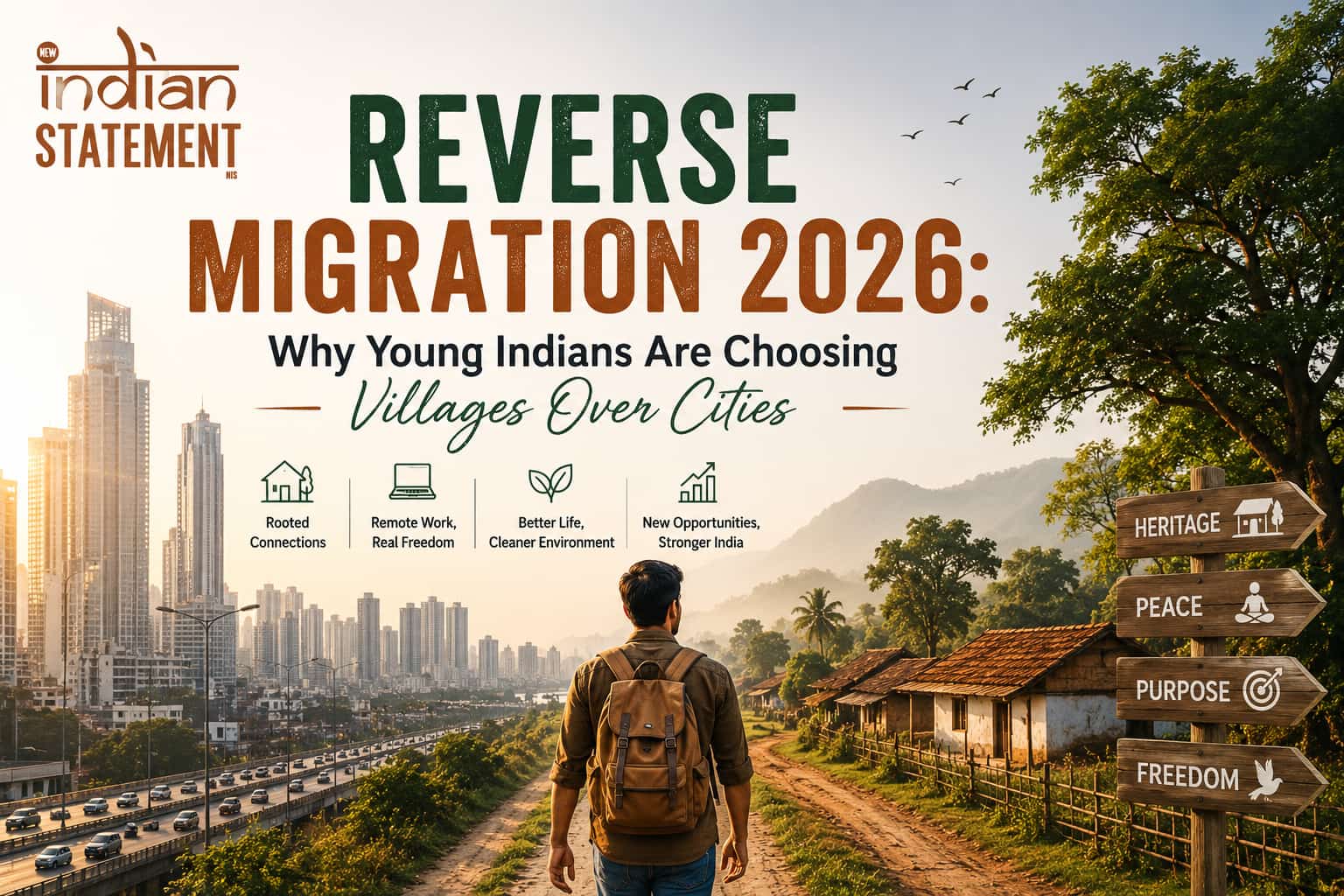
Reverse Migration 2026: Why Young Indians Are Choosing Villages Over Cities
Culture By New_Indian_StatementAnkita Deshmukh gave Bengaluru seven years of her life. A decent job, a rented 1BHK in Indiranagar, a Swiggy order most nights she didn’t have the energy to cook, and a commute that quietly stole two hours from her every single day. On paper, she’d made it. Her parents, back in a village near Kolhapur, told relatives their daughter worked at a big company in the city. That sentence carried weight, once.
These days, Ankita does the same job from her grandfather’s house. Remotely. She’s turned the old cowshed into a scrappy little workspace — fibre broadband, a rickety table, a window that opens onto her mother’s vegetable patch. In the evenings she pulls weeds instead of scrolling Instagram. She says she sleeps better now than she has in ten years. And she means it.
Her story isn’t rare anymore. It’s turning into something you hear again and again, in different accents, from different states. There’s a name for it now: reverse migration India 2026.
The Great Reverse Migration of 2026:
For most of independent India’s history, migration ran one way — villages emptying into cities. Young people left home chasing jobs, hospitals, better schools, a shot at something bigger. Mumbai, Delhi, Bengaluru grew fat on that steady inflow of ambition, decade after decade.
Something quieter is happening now, threaded through that old story. A section of young, educated Indians — techies, designers, consultants, the odd content creator with a ring light — are choosing to go back. Not the way migrant labourers were forced to during the lockdown years, packing whatever they could carry and walking home. This is different. This is a choice, made with a laptop bag over one shoulder and fibre already booked at the other end.
Let’s be honest about scale here, though — this isn’t some great emptying of India’s metros. The louder, more visible shift right now is people moving from Tier-1 cities to Tier-2 ones. Indore. Jaipur. Pune. Chasing cheaper rent and a slower pulse without giving up career access entirely. But sitting inside that bigger trend is a smaller, more personal one — individuals and young families going all the way back. To the actual village. The grandparents’ house. The roots. And it’s the kind of shift that shows up on dinner tables and in family WhatsApp groups long before it ever shows up in a government survey.
Why Are Young Indians Leaving Cities?
City Burnout Is Real
Ask any 27-year-old in Gurugram how they’re doing. You’ll get some version of “surviving,” said with a tired little laugh. The nine-hour workday has stretched, without anyone officially agreeing to it, into eleven or twelve. Add the commute. Add notifications that refuse to stop at 7 PM. Add the quiet, constant comparison that comes from scrolling through everyone else’s highlight reel at midnight. Burnout stopped being a buzzword a while back — for a lot of people, it’s just Tuesday now.
Therapists in metro cities will tell you, if you ask, that they’re seeing more young clients than ever — anxiety, broken sleep, a strange flatness that settles in even when the career looks fine from the outside. There’s a particular kind of exhaustion that comes from running hard and somehow going nowhere. City life, for a good chunk of Gen Z and young millennials, has started to feel exactly like that.
The Rise of Remote Work
Here’s the thing that actually made all this possible: work-from-home never fully vanished, no matter how many companies rolled out return-to-office mandates with great fanfare. Large parts of India’s white-collar workforce — IT, marketing, finance, ed-tech, content — still operate hybrid, or fully remote.
And once your job stops caring whether you’re logging in from a Koramangala apartment or a farmhouse near Wayanad, the question quietly changes. It’s no longer “can I leave the city.” It becomes “why haven’t I already?” Remote work from Indian villages in 2026 isn’t some quirky exception anymore. It’s a real, growing way of earning a living — unglamorous Tuesdays included.
The Cost of Urban Living
Then there’s money. This is the part nobody says out loud in a job interview, but everyone whispers about after two drinks.
Rent in Mumbai, Bengaluru, Delhi-NCR has climbed hard over the past few years — eating a third, sometimes more, of a young professional’s salary before a single bill gets paid. Add EMIs. Add the daily cab rides because you’re too drained to take the metro. Add ordering in because cooking, after a twelve-hour day, feels like a luxury you can’t afford time for. A “good” city salary has a strange way of vanishing by the 25th of the month.
News reports this year have flagged professionals pulling in well over a lakh a month in metro cities and still finding it hard to save anything meaningful. Now compare that to a village, where the ancestral house is already paid off, vegetables come from the backyard, and a scooter covers every errand. The math starts looking almost embarrassingly different.
Why Villages Are Becoming Attractive Again:
Ancestral Homes and Emotional Connections
There’s a pull that no spreadsheet can quite explain. The house you were born in. The one your grandfather built brick by brick, arguing with masons over the price of teak. For most returnees, the decision starts in the chest, long before it ever reaches the calculator.
Ancestral home renovation in India has become its own quiet little movement. Young people are hiring local masons and architects to bring back Kerala tharavads, Rajasthani havelis, Konkan wadas — keeping the old bones, the courtyards, the wooden beams, the verandahs, while sneaking in proper wiring, attached bathrooms, and yes, Wi-Fi that actually holds a video call. Instagram is flooded with these renovation reels now. And oddly enough, they get more genuine engagement than most polished city apartment tours ever managed.
Cleaner Environment and Better Quality of Life
Spend one winter in Delhi and one in a village in Himachal, back to back, and you won’t need anyone to explain the difference. Clean air that doesn’t sting your throat. Nights quiet enough to actually sleep through. Stars you can see without squinting. Food that hasn’t travelled two hundred kilometres to reach your plate, wrapped in three layers of plastic.
For young parents, this weighs heavier than it used to. Raising a child somewhere they can run around barefoot, breathe air that isn’t a public health hazard, and grow up surrounded by cousins and grandparents — instead of inside a gated society with a “kids’ play area” roughly the size of a parking slot — has become a real, stated reason for the move. Not just a sentimental afterthought tacked on at the end.
Entrepreneurship Opportunities in Rural India
This is where the story gets genuinely interesting. Villages aren’t just where people retreat to anymore. They’re becoming places people build things.
Homestays are booming across Uttarakhand, Himachal, Meghalaya, and the Western Ghats belt in Karnataka — run by young returnees who understand, instinctively, what a city tourist actually wants. Comfort. A bit of aesthetic. An experience that feels authentic without the discomfort their own grandparents quietly put up with for decades. Others are going further still — organic farming labels, spice and honey exports, handloom revival brands, dairy startups, even agri-tech ventures running drones and soil sensors over family land that used to grow nothing but rice and worry.
None of this works without connectivity, though. Digital infrastructure in rural India — better 4G, expanding fibre through schemes like BharatNet — has quietly made it possible to run an Instagram page, accept UPI payments, and ship orders pan-India, all from a village where the population barely touches two thousand.
How Gen Z Is Redefining Success:
Ask a Gen Z employee what success looks like these days, and “corner office” rarely comes up anymore. You hear other words instead. Balance. Purpose. Flexibility. Peace, of all things.
This generation watched their parents chase promotions and EMIs for two straight decades, often at the cost of their own health and time with family they can’t get back. They’re not signing up to repeat that script — not quietly, anyway. Village life for Gen Z isn’t about abandoning ambition. Plenty of them are still building businesses, freelancing across time zones, running remote teams at 11 PM if the client’s in another continent. It’s more that they’ve stopped accepting ambition has to arrive bundled with exhaustion, as though the two were a package deal nobody could opt out of.
Picture a 24-year-old UX designer you’d recognise from any Bengaluru co-working space. Except now she runs her own small design studio out of her family’s Konkani home, and at 4 PM she walks to the beach — not because she’s “settled down,” whatever that means, but because she’s decided that’s what a life worth living should actually feel like on a Tuesday afternoon.
The Economic Impact of Reverse Migration on Rural India:
Even a small, steady trickle of educated, digitally-fluent young people moving back sends ripples outward. A returnee hires a local mason for the renovation. Buys cement and timber from the town twenty minutes away. Employs house help. Starts a small business that puts three or four local youths on payroll instead of nudging them toward the next city bus out.
Government schemes — DAY-NRLM, RSETIs, various state-level rural entrepreneurship pushes — are trying to formalise support around exactly this. Skill training, small business loans, infrastructure grants for rural clusters. It’s early days, and policy folks will rightly point out that most of India’s rural-urban migration still runs the old, traditional way — people leaving villages in search of stable work, not the other way round. But every renovated haveli turned into a workspace, every homestay booking, every organic farm brand shipping pan-India adds one more brick to a rural economy that’s leaned almost entirely on agriculture and remittances for far too long.
Challenges of Moving Back to Villages:
It would be dishonest to pretend this is easy. It isn’t.
Internet, though far better than it was five years ago, still goes patchy in interior pockets — and one bad monsoon can knock out power or fibre for days at a stretch, no warning given. Healthcare remains a genuine worry. A village with beautiful air quality and the nearest multi-speciality hospital two hours down a winding road is a real trade-off, not a small one, especially for a young family with kids. And then there’s the social friction — relatives, neighbours, that one uncle at every wedding who can’t fathom why anyone would “downgrade” from a city job to farm life, no matter how the numbers actually stack up.
There’s also the sheer grind nobody photographs for Instagram. Old land records buried in some tehsil office. Property disputes between cousins who haven’t spoken in years. Contractors who vanish mid-project with half the advance. Renovating a hundred-year-old house without gutting its soul takes more patience than most city jobs ever demanded. Reverse migration isn’t a Pinterest board come to life. It’s early mornings, paperwork headaches, and a fair share of trial and error — same as any big decision worth making.
What Reverse Migration Could Mean for India’s Future:
Zoom out to 2030, and even a modest version of this trend could reshape parts of rural India in ways that matter. Urban planners have argued for years that India’s biggest cities are groaning under a population load they were never built to handle. Infrastructure, housing, civic services — stretched thin across Mumbai, Delhi, Bengaluru, with no real relief in sight. A gentle, steady counter-flow of skilled, connected people moving back into smaller towns and villages could ease some of that pressure. And bring fresh energy, income, ideas into places that have spent decades watching their sharpest young people leave and rarely come back.
Some economists are already betting on the rise of genuine “digital villages” by 2030 — clusters with dependable broadband, working co-working spaces, decent schools, an economy that mixes farming with tourism and remote-first businesses without treating either as lesser. It won’t replace the pull of the big city anytime soon. Realistically, it might never fully will. But it doesn’t need to replace anything to matter. An India where a village doesn’t automatically mean “left behind” would be a genuinely good outcome — for cities and villages both.
Final Thoughts:
Reverse migration in 2026 isn’t a mass movement. Not yet, and it would be misleading to dress it up as one. But it’s real, it’s growing, and it’s deeply human in a way spreadsheets rarely capture — young Indians deciding that a slower, more rooted life doesn’t have to mean a smaller one.
For Ankita in Kolhapur, and for the thousands quietly doing what she did, the city taught them how to build a career. The village is teaching them, now, how to build a life around it. That’s not retreat. If anything, it’s a fairly brave rewrite of what “making it” was ever supposed to mean.
Frequently Asked Questions:
1. What is reverse migration in India, and why is it happening in 2026?
Reverse migration is when people move from cities back to villages or smaller towns, flipping the usual rural-to-urban flow. In 2026, it’s mostly driven by remote work, rising city living costs, burnout, and a growing pull toward a slower, more rooted lifestyle among young Indians.
2. Is reverse migration a large-scale trend across India right now?
Not yet, honestly. Most of India’s population is still moving toward cities for jobs and services — that hasn’t flipped. But a visible, steadily growing group of young remote workers is choosing to relocate to ancestral villages or smaller towns, and that group keeps getting bigger.
3. Can I really keep my city job while living in a village?
For a lot of roles, yes. IT, content, design, consulting, digital marketing — these travel well now. Rural digital infrastructure has genuinely improved, with better 4G and expanding fibre broadband through initiatives like BharatNet, especially in larger village clusters.
4. What’s the hardest part of moving back to a village?
Patchy internet in interior pockets, limited access to advanced healthcare, renovation headaches around old property records, and occasionally, relatives who just don’t get why you’d want to leave a “good” city job behind.
5. What kind of businesses are young returnees actually starting?
Homestays and rural tourism come up a lot. So do organic farming and agri-exports, handloom and craft revival brands, dairy and agri-tech ventures, and content businesses — YouTube, Instagram — built around showing real village life to people who’ve never seen it.