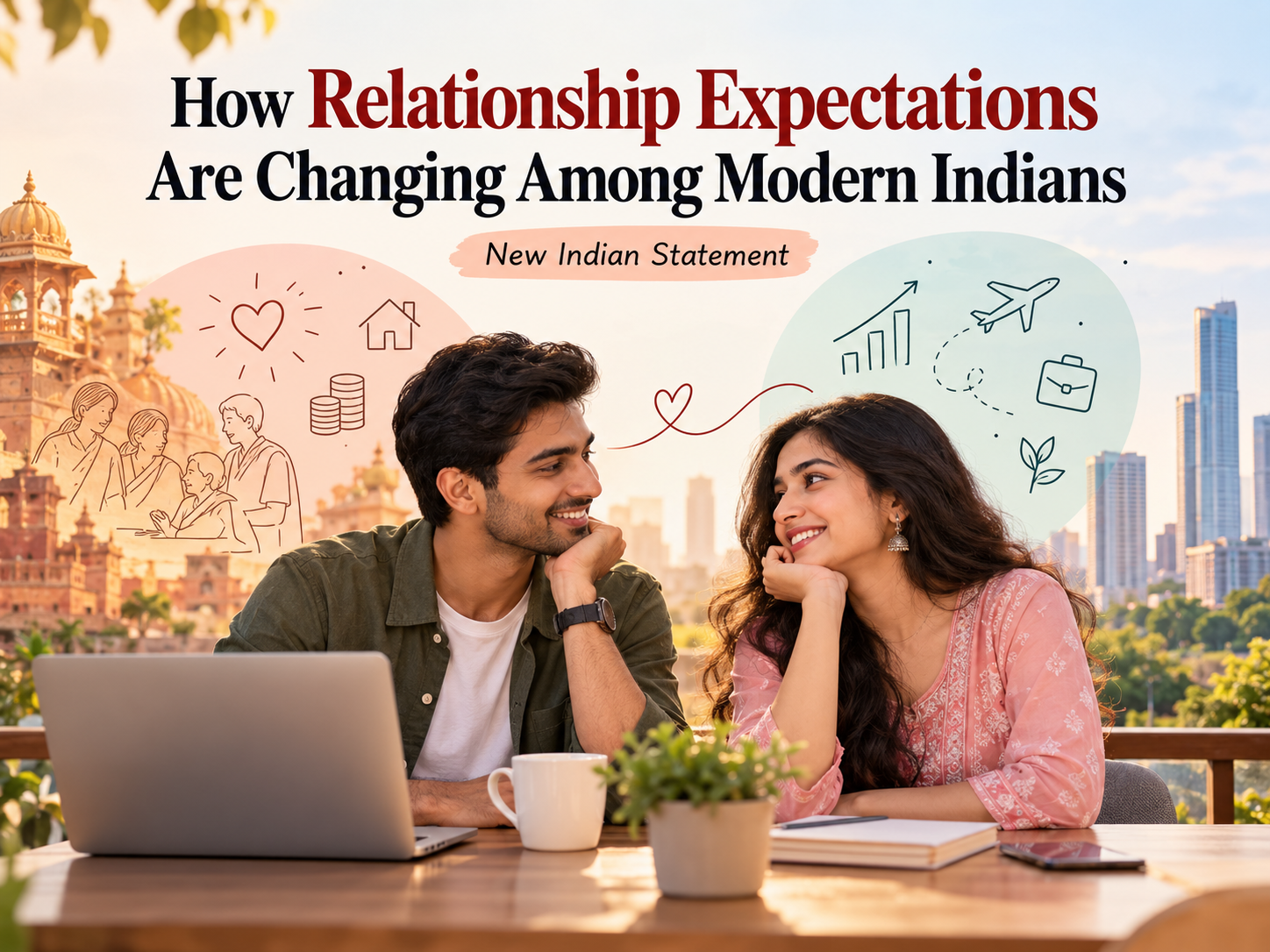
How Relationship Expectations Are Changing Among Modern Indians
Think about how your parents got married, then think about how your friends are doing it now. Somewhere between the two, the whole idea of what you should want from a partner shifted. That shift is what we mean when we talk about modern Indian relationship expectations.
A generation ago, the checklist was fairly simple. Good education, steady job, decent family, and the elders’ blessing. Plenty of people still start there, and honestly, that’s fine. But ask someone in their late twenties what they’re looking for and you’ll hear different words. Someone who listens. Someone who won’t make me choose between my job and my marriage. Someone I can be honest with about money, or about a bad week.
None of this means Indians are walking away from tradition. Most people are trying to keep the parts of it they love and drop the parts that don’t fit their lives anymore. At New Indian Statement, we think that tug of war between family expectations and personal choice is one of the most interesting stories in the country right now.
Talking Matters More Than Matching
Biodatas used to do a lot of the heavy lifting. Height, qualifications, salary, gotra, city. For many families they still do, especially in arranged marriages.
But ask people who’ve been married a few years what actually matters and it’s rarely the biodata. It’s whether you can sit across from each other after a fight and still talk. It’s whether one person can say “I’m not okay today” without the other rolling their eyes.
Take a software engineer who works until 9 pm most days. She might not care much about her partner’s package. She just wants someone who won’t sulk about the late nights. Another person might want exactly the opposite, a partner who is home by seven and wants to talk about everything. Neither is being unreasonable. They just know themselves better than earlier generations were encouraged to. That’s really what modern Indian relationship expectations come down to: people are getting specific about what makes them feel safe.
Love Marriage, Arranged Marriage, and Everything in Between
The old debate was love versus arranged, as if you had to pick a team. These days a lot of couples ignore the debate entirely.
A couple meets at work, dates for two years, then takes the relationship to the parents. Another couple is introduced by an aunt, texts on WhatsApp for three months, meets a few times, and decides together. Which one is “arranged”? Honestly, the label barely matters anymore.
What does matter is that the person getting married has a real say. Even in families where parents lead the search, it’s now common for the two people to ask each other direct questions before saying yes. Do you want to work after marriage? Are we living with your parents? How do you feel about kids, and when? A few years ago, asking those things on a second meeting might have seemed pushy. Now it looks like common sense.
Money, Independence, and Who Pays for What
When both people earn, the conversation changes. Nobody is quietly assuming the husband will handle everything and the wife will manage the house.
Still, money is where a lot of couples get stuck. One wants to put every spare rupee into a flat and an EMI. The other would rather spend on travel or a master’s degree abroad. Add in a parent who needs monthly support, and suddenly a simple budget feels loaded.
The couples who handle this well usually aren’t the richest ones. They’re the ones who talked about it early, before the wedding, when it felt a bit awkward. Equal salaries aren’t the point. Being honest about what you earn, owe and want is.
There’s a shift on the other side too. More men now say they want a partner who shares the load at home, cooking, cleaning, remembering the pediatrician appointment, instead of assuming it’s somebody else’s job.
Careers and Personal Space
Ask a twenty-something woman or man whether they’d give up their career after marriage and a lot of them will say no, quite firmly. That wasn’t always the case.
So the practical questions come up fast. If one of us gets a job in Bengaluru and the other is in Delhi, what then? Who relocates? Whose career gets priority this time, and what about next time?
Then there’s the quieter issue of space. Some people want to spend every weekend with their partner. Others need a Saturday with college friends, or an hour alone with a book, and that has nothing to do with how much they love the person. The trouble starts when one partner reads it as distance. Many couples are learning, sometimes the hard way, that closeness doesn’t have to mean doing everything together.
Boundaries Are Now Part of the Conversation
Here’s a small example. One partner thinks calling five times a day shows care. The other thinks it shows a lack of trust. Nobody’s wrong, but if they never say it out loud, they’ll spend months being quietly annoyed.
Boundaries sound like a heavy word, but most of them are ordinary. Do we share phone passwords? Is it okay to post each other’s photos? How much of our fights do we tell our parents? What about friendships with exes?
Setting these isn’t about control. It’s about agreeing on what feels respectful. It also makes it easier to notice when something isn’t okay. Constant monitoring, guilt trips, sulking as punishment, being pressured into things you don’t want. These get excused as “because I love you” far too often, and more people now recognise that for what it is.
Dating Apps, Instagram, and the Comparison Trap
Apps like Bumble, Hinge and the matrimonial sites have made it far easier to meet someone outside your own circle. You can chat first, figure out if there’s a spark, and take your time. For people in smaller towns, that’s a real change.
But there’s a flip side. When there are hundreds of profiles, it’s tempting to keep swiping for someone slightly better. Edited photos and polished bios don’t tell you whether a person is kind. And then there’s Instagram, where every other couple seems to be in Santorini or celebrating their anniversary with a surprise cake.
It’s worth remembering that a couple who never posts anything might be far happier than the one with a perfect grid. Apps can introduce you to someone. After that, it’s ordinary things like honesty, patience and showing up that decide how it goes.
Mental Health Is Finally Part of the Talk
A decade ago, saying “I’ve been feeling anxious lately” to a prospective partner would have raised eyebrows. Now plenty of people say it, and the other person says, “me too.”
That openness helps. When you know your partner had a rough few years, or gets stressed around deadlines, you can respond with some understanding instead of guessing. At the same time, people are realising a partner can’t be a therapist for everything. You can support someone without being responsible for fixing them.
Couples counselling is slowly losing its stigma too. Going to a counsellor doesn’t mean the marriage is broken. Sometimes it just means you keep having the same argument and need someone neutral to help untangle it.
Family Still Matters. Couples Just Want a Say.
Let’s be clear, family isn’t going anywhere. Parents often help with money, advice, childcare and a hundred small favours. For many couples, a Sunday call with the in-laws is as normal as brushing teeth.
The friction comes when family expectations pile up. How big should the wedding be? Where will you live? When are you having a baby? Why is she still working? The couple in the middle can feel squeezed, especially if one partner feels like they’re always the one explaining and apologising.
Many couples now try to handle it calmly. They don’t cut anyone off. They just decide early which decisions are theirs, and they tell relatives politely but clearly. It doesn’t always work smoothly, but it’s a lot better than saying yes to everything and resenting it later.
Marriage as a Partnership, Not Just a Milestone
For a long time, marriage was a box to tick by a certain age. Plenty of people still feel that pressure, and “log kya kahenge” hasn’t exactly disappeared.
But more people are asking what the day after the wedding looks like. Who cooks? Who handles the bills? Do we agree on kids? Will you back me if I switch careers at thirty-two? Those questions feel less glamorous than choosing a venue, but they decide whether the marriage actually works.
Some people want to wait until they’ve settled their career or saved some money. Others get married young and are perfectly happy. There’s no single right age. The real change is that more people see marriage as a decision they make, not a deadline they meet.
Where New Indian Statement Fits In
New Indian Statement exists to tell the stories of how modern Indians live, think and love. Expectations about relationships look very different in Mumbai than in a small town in Uttar Pradesh, and different again between a 24-year-old and a 38-year-old. You can’t capture that with one sweeping statement.
So we try to look at the real picture. How dating is changing. How people balance tradition with independence. What emotional compatibility actually means in practice. How families react, and how technology plays into all of it.
We’re not here to say traditional relationships are outdated, or that modern ones are better. Both can work when two people respect each other. We just want readers to think about what they personally want, and maybe feel a little less alone in figuring it out.
Conclusion
Relationships in India are changing, slowly and unevenly, but they are changing. People care more about emotional connection, shared responsibility, personal ambition and honest conversation than they did a generation ago. At the same time, family and tradition still matter deeply to millions.
So the future probably won’t be a clean break from the past. It’ll be a mix, different for every couple. That’s really the main takeaway about modern Indian relationship expectations: there’s no single formula, and each pair has to work out their own version of trust, space and commitment.
A good relationship isn’t measured by how closely it matches what society expects. It’s measured by whether two people feel understood, respected and supported, day after day.
Frequently Asked Questions (FAQs)
What are modern Indian relationship expectations?
Mostly emotional compatibility, trust, respect, honest talk about money and room for each person’s goals. How much each of these matters depends on the person and their family.
How are relationships changing among young Indians?
Young Indians are paying more attention to compatibility, careers, mental well-being and having a say in who they marry. Apps and online chats have also changed how people meet.
Are arranged marriages still popular in India?
Yes, very much. The difference is that couples now usually get more time to talk and decide for themselves before agreeing.
Why is emotional compatibility important?
Because it decides how you handle disagreements and bad days. Shared hobbies are nice, but being able to talk honestly is what keeps a relationship steady.
Does financial independence affect relationships in India?
It does. It gives people more confidence to make their own choices and makes conversations about savings, spending and household duties more open.
How can couples balance family traditions with personal choices?
Talk to each other first, then speak to the family respectfully and clearly about which decisions are yours. You can respect your family without handing over every decision.
What role does New Indian Statement play in conversations about modern relationships?
New Indian Statement covers changing attitudes, cultural traditions and real experiences of modern Indians, so readers can see different viewpoints on love, marriage and partnership.
What is the key to a healthy modern relationship?
Honesty, respect, shared responsibility and the ability to disagree without hurting each other. Each person should feel valued and still be themselves.