Second Career Options India: Best Careers for Professionals
Second Career Options India: What Actually Works When You Want Out
You don’t need a dramatic reason to want a different career. Sometimes it’s just a Tuesday afternoon, a pointless meeting, and a thought that arrives out of nowhere: I can’t do this for another twenty years.
If that thought brought you here while searching for second career options India, good. It means you’re taking it seriously instead of ignoring it. We cover stories like this at New Indian Statement, and the questions people ask rarely change. Is it too late? Will I have to start at the bottom? What if I fail?
Short answers: probably not too late, probably not the bottom, and failing a little is part of the process. Let’s go through it properly.
First, why does this happen?
Mostly because careers in India often get chosen for you. Marks decided the stream. The stream decided the degree. The degree decided the first job, and the first job decided everything after. Nobody stopped to ask what you actually liked.
Then add the usual stuff. Stagnant pay, a boss who takes credit, layoffs in your company, and the constant talk that AI will take over half of what you do. It’s no surprise people start looking sideways.
Take stock before you take a course
Everyone jumps to “which course should I buy?” Wrong first step.
Sit down and list what you can already do. Not job titles, actual abilities. Can you handle an angry client? Explain a complicated thing simply? Keep a team on schedule? Spot errors in a spreadsheet at a glance? These carry over, and they’re the reason experienced people don’t start from zero when they explore second career options India has to offer.
Now, the options.
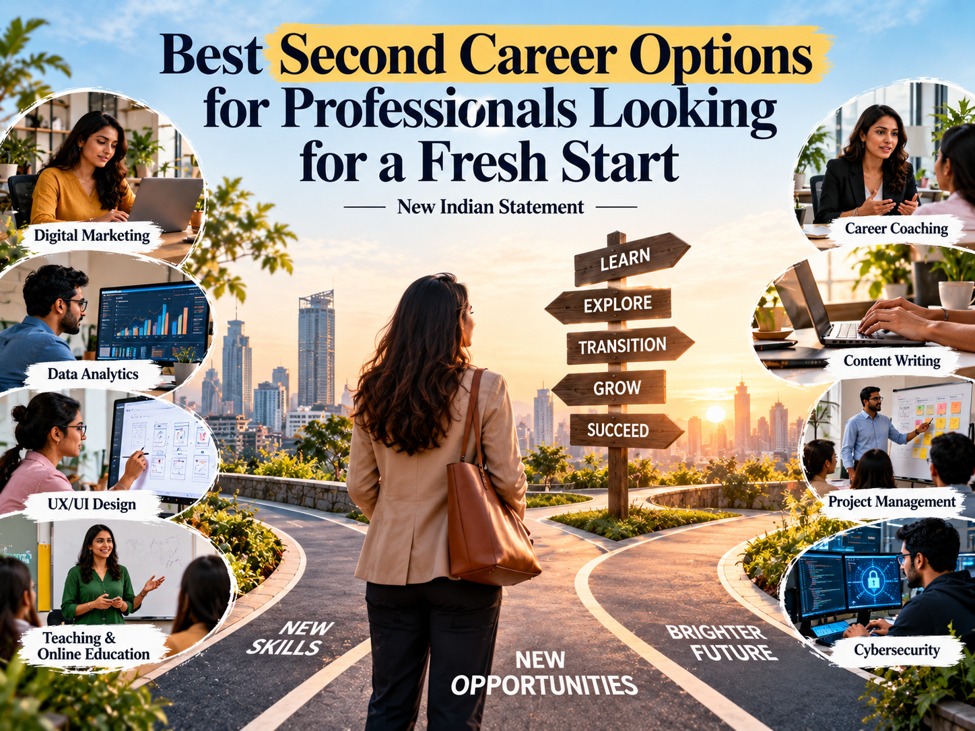
Digital marketing
Probably the most common landing spot, and for decent reasons. It has many entry points: SEO, paid ads, social media, email, content, analytics. A person from sales understands persuasion. A journalist understands headlines. A customer-support veteran understands complaints, which is gold for reputation work.
But here’s the thing people skip. Employers don’t want to see that you watched forty hours of YouTube. They want to see something you ran. Make a small site, run a tiny ad budget for a local business, track what happens. Even a modest result tells them more than a certificate.
Content writing and strategy
AI can now produce a bland blog post in seconds, which sounds like bad news for writers. In practice it means bland writing has lost its value, and knowledge has gained. A former nurse writing about patient care, a CA explaining tax changes, a mechanical engineer describing how a machine actually fails: that kind of writing is still hard to fake.
If you can write clearly and you know a subject well, don’t let the AI panic stop you.
Project management
Think about who at your office quietly keeps things moving. Chasing updates, fixing the timeline, calming people down. That person is already doing project management for free.
Experience in IT, construction, operations or marketing carries real weight here. A certification like PMP can help with some employers, but it won’t replace a record of getting things done.
Data analytics
If you like asking “why did sales drop last month?” and then actually digging for the answer, look at this. You’d work with Excel, SQL, a dashboard tool such as Power BI, and later Python.
What helps experienced people is context. An analyst who has worked in a hospital or a retail chain understands the numbers in a way a fresher can’t. That context is hard to teach.
UX and UI design
It suits people who like both logic and creativity. UX is how a product works for the person using it. UI is how it looks. Figma is free to start with and easy enough to learn.
The thing that gets you hired is a small portfolio. Two or three honest case studies: here was the problem, here’s what I tried, here’s what improved. A drawer full of course certificates does less.
Cybersecurity
I’ll be straight, because many websites aren’t. This isn’t a three-month switch. You need real technical depth, and building it takes a long time. If you already work in IT or networking, it’s a natural next step. If you’re coming from a non-tech job, be ready for a long climb and be suspicious of anyone promising a quick job.
HR and talent development
Good HR is more than payroll and leave policy. It’s hiring, training, handling conflict and keeping decent people from leaving. If you’ve managed teams and people tend to come to you with problems, you may be a better fit than you realise. Learn the labour rules and a bit of HR software, and you’ll be ahead of many applicants.
Teaching and online education
Your classroom doesn’t need walls. People teach through live online batches, recorded courses, private coaching and corporate workshops. Someone with fifteen years in finance has real examples, and many learners prefer hearing from a practitioner over reading a textbook. [Add a real example here, for instance a teacher, trainer or course creator you know who switched.]
Coaching and mentoring
Looks easy from outside. It isn’t. Trust takes time. Get properly trained, be clear about what you don’t know, and never promise results you can’t control. Most coaches begin with a few free sessions, a decent LinkedIn profile and word of mouth.
Freelancing or a small business of your own
A designer takes on three clients. A marketer starts a one-person agency. An accountant looks after local shops. You can test any of this on evenings and weekends before you resign, which is the biggest advantage.
The risk is uneven income. Some months the money comes on time. Some months it doesn’t. Plan for that before you leave anything.
How to choose without going in circles
Don’t pick something because a reel said it pays well. Reels are not career counsellors.
Try three lists on a sheet of paper. What you’re good at. What you actually enjoy on an ordinary day, not a good day. And what employers are hiring for right now. For the last one, open ten listings on LinkedIn or Naukri and note which skills keep repeating.
Where the lists overlap, look there first. It won’t be perfect. It will be better than guessing.
Keep your job for now
Almost everyone who has done this says the same thing. Don’t resign in a burst of anger. Learn in the evenings, try a small project, talk to people already doing the work. Build a cushion that covers several months of expenses, because switching usually takes longer than people expect.
Platforms like Coursera, NPTEL, Google’s career certificates and government skilling programmes under Skill India make learning cheap or even free. Spending a lakh on a course shouldn’t be your first move.
Do you need another degree?
Sometimes. Law, medicine and school teaching need formal qualifications, no way around it. But in marketing, content, design and analytics, proof of skill usually beats another certificate. Before paying for any programme, read what employers in that field actually ask for.
Your old career isn’t wasted
Say you’ve spent ten years in sales. You understand why customers say no, how to handle objections and how to close. That’s useful in marketing, in client management, even in coaching. A manager moving into HR already knows how teams fight and make up.
The trick is to explain the link in plain language, on your CV and in interviews. Employers hire someone who can tell them why the switch makes sense. That’s what makes second career options India workable for experienced people, not just for fresh graduates.
Talk to people first
Find someone who already does the job and message them. Ask what a normal day looks like and what they’d do differently if they started again. LinkedIn, WhatsApp groups and local meetups work well for this. Don’t open with “any vacancies?” Ask for ten minutes. Most people agree, and a few of those chats turn into referrals months later.
About New Indian Statement
New Indian Statement is a platform for stories, ideas and conversations about contemporary India. We write about careers, lifestyle, culture, business and the changing attitudes of ordinary people. Career switching shows up in more of our stories every year, and we plan to keep covering it.
Frequently Asked Questions
1. What are the best second career options for experienced professionals?
Digital marketing, data analytics, project management, teaching, content strategy, UX/UI design, HR, cybersecurity, coaching and freelancing are some options worth exploring.
2. Can I change my career after 30?
Yes. Career changes after 30 are increasingly common. Your previous professional experience can become an advantage when moving into a related or completely new field.
3. Do I need another degree for a second career?
Not always. Some professions require formal qualifications, but many digital and business roles focus heavily on practical skills, portfolios and relevant experience.
4. What is the safest way to change careers?
Start gradually. Learn the required skills, build practical experience and test the new field while maintaining your current income whenever possible.
5. Is freelancing a good second career?
Freelancing can be a good option for professionals who have a marketable skill and are comfortable managing clients, projects and income fluctuations.
6. How long does a career change take?
There is no fixed timeline. A transition can take a few months for some digital roles and several years for professions requiring formal education or significant technical training.
7. How do I choose among different second career options India?
Consider your existing skills, interests, financial requirements, learning time, lifestyle goals and current market demand before making a decision.
Conclusion
A second career doesn’t cancel your first one. It borrows from it. The years you’ve already spent gave you habits, instincts and knowledge that a fresh graduate simply doesn’t have.
So take your time. Learn what employers want, build some proof, protect your savings and talk to people who’ve done it. You might not get it right on the first attempt, and that’s allowed. If you’re thinking about second career options India, start small and keep going. New Indian Statement will keep telling the stories of people who did.